Native Instruments Unveils Super*Saw Synthesizer in Collaboration with PC Music Founder A. G. Cook

The landscape of electronic music production and modern sound design has long been defined by a handful of ubiquitous, era-defining sonic textures, chief among them the stacked sawtooth wave. Emerging prominently from the virtual-analog digital revolution of the mid-1990s, the "supersaw" swiftly became the foundational engine driving high-energy rave anthems, euphoric pop hooks, and monumental wall-of-sound club productions. Continuing this rich lineage, audio technology giant Native Instruments has officially announced the launch of SuperSaw (stylized as SuperSaw and pronounced SuperStarSaw), an innovative software synthesizer developed in close partnership with visionary producer, songwriter, and PC Music founder A. G. Cook.
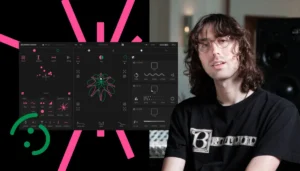
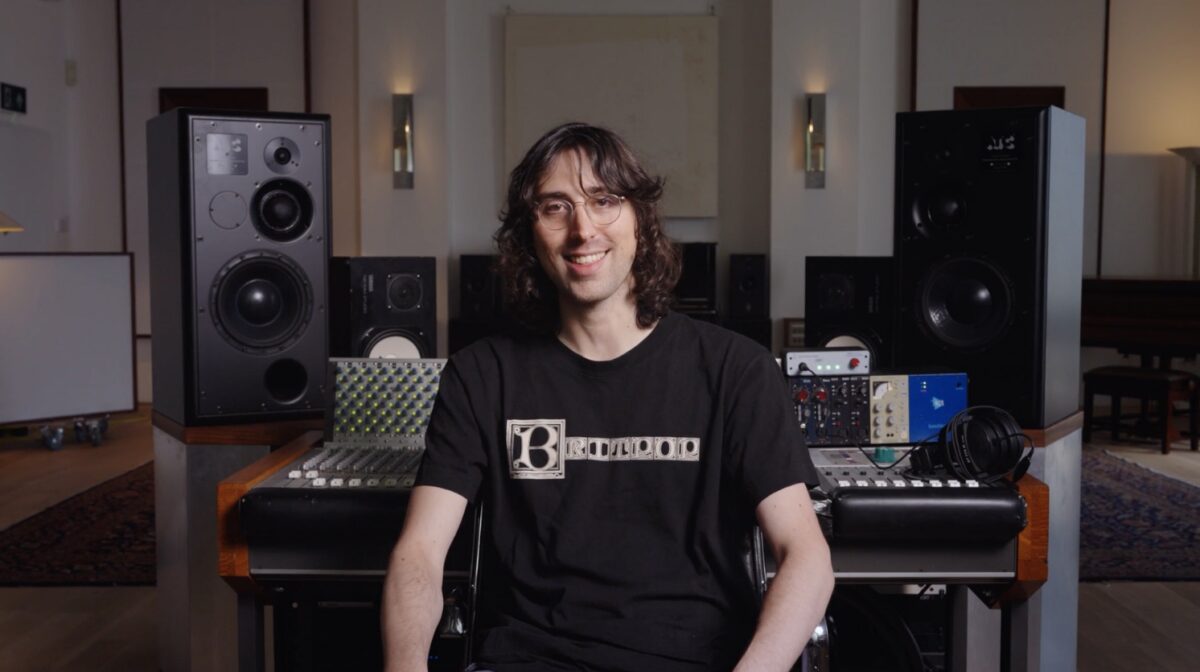
Unveiled alongside an exclusive artist session hosted at Baltic Studios in London, the new instrument represents a major step forward in virtual instrument design. By distilling complex, multi-layered workflows into a single, highly intuitive and expressive powerhouse, Super*Saw aims to give contemporary producers immediate access to the hyper-detailed, aggressive, and harmonically rich palettes that have come to characterize Cook’s decade-long career.
Chronology and Development: From Tedious DAW Workarounds to Dedicated Hardware-Style Software
The conceptual roots of SuperSaw stretch back across years of meticulous, often exhausting production techniques utilized by Cook. Known universally for his boundary-pushing contributions to modern hyperpop—including extensive production work with global superstar Charli XCX, acclaimed solo LPs such as 7G and Apple, and his recent full-length record Britpop*—Cook frequently leaned on hyper-layered sawtooth configurations to achieve his signature sound.
Historically, however, achieving these dense, evolving textures was far from straightforward. In previous studio sessions, constructing a classic A. G. Cook-style supersaw patch required tedious, manual workarounds within digital audio workstations (DAWs). Producers were routinely forced to duplicate tracks across multiple software instances, meticulously write complex automation for fine-tuning, and manually phase-align disparate plugins just to generate a cohesive chord progression.
Reflecting on the grueling production process behind tracks like his 2020 single "Stargon," Cook noted that traditional methods often stripped the musicality out of the performance process.
"Doing some of those more classic A. G. Cook-style supersaw sounds can sometimes be the slowest part of my process," Cook remarked during his studio walk-through at Baltic Studios. "I was using all these different plugins and their different detune functions to form a chord progression, but it was a real pain to get all the automation right and meticulously line everything up. It never felt like I was playing the synths or interacting with them in a musical way."
Recognizing the need for a more streamlined yet infinitely deep instrument, Cook collaborated with Native Instruments to design a dedicated synthesis engine centered entirely around the raw, unfiltered potential of the sawtooth wave. Rather than diluting the instrument with extraneous oscillator types, Super*Saw restricts its architecture to pure, harmonically dense sawtooth foundations, forcing creators to explore the outer edges of stacking, detuning, and modulation.
Technical Architecture: Inside the Pink and Green Dual-Layer Engine
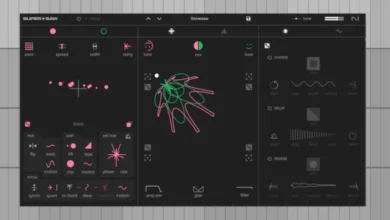
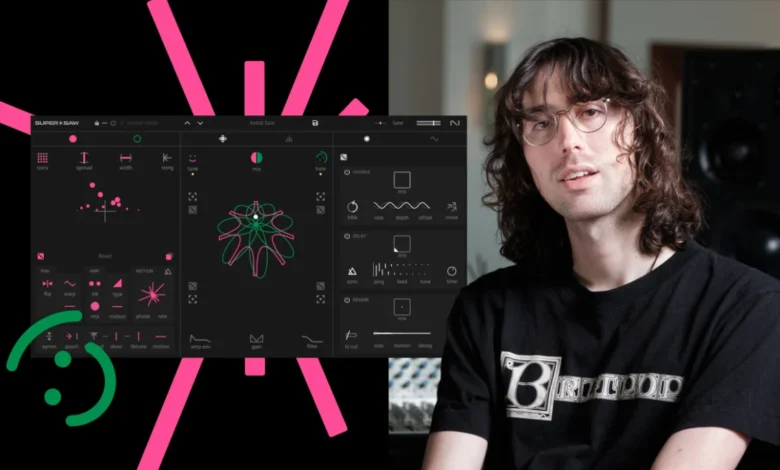
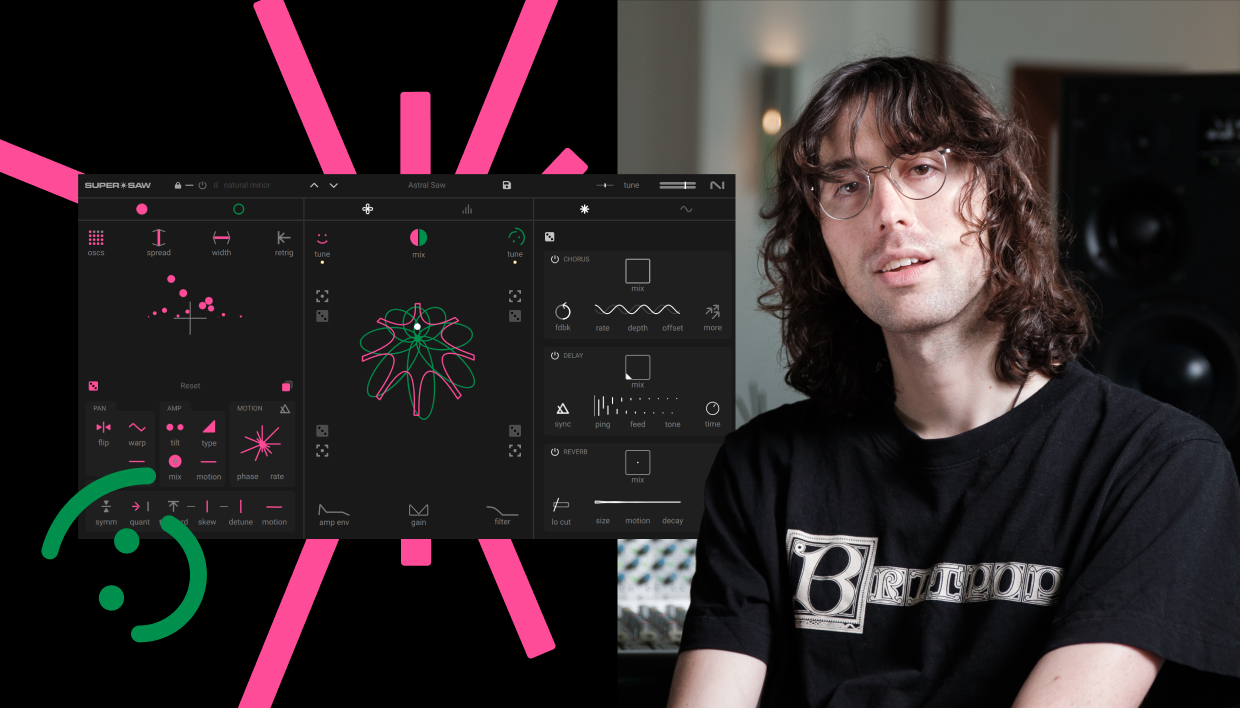
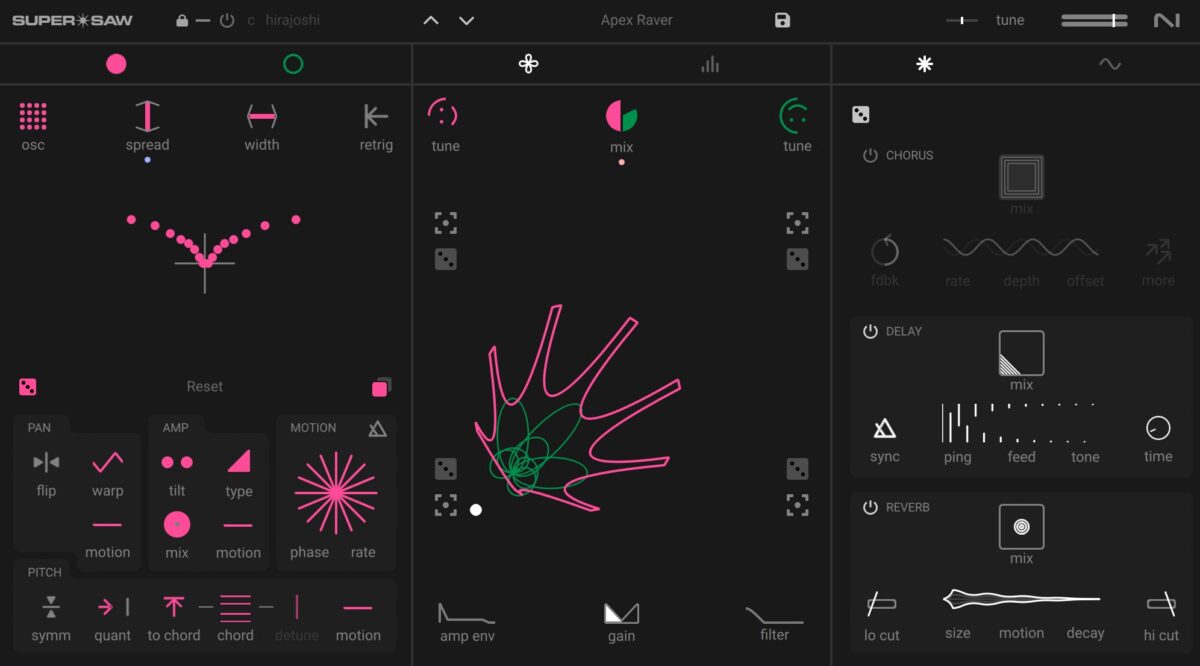
At the technological heart of Super*Saw lies a robust dual 8-voice sawtooth oscillator system. To make the interface visually and functionally distinct, the instrument is divided into two separate, color-coded layers: pink and green.
This design choice was born directly from Cook’s personal production methodology, which frequently employs contrasting layers to balance chaos and stability within a mix.
"I had a strong sense that it would be two layers, these two groups, because that’s often how I think about building sounds," Cook explained. "It’s almost like having a comedic duo. One half could be going crazy and the other half could be anchoring it with a fundamental note. It then became obvious that pink and green would stack really well while feeling distinct, so you have these two vivid, contrasting colour worlds."
The user interface is engineered heavily around real-time performance and dynamic interaction rather than static, pre-programmed automation. The inclusion of a 4-corner Morpher allows musicians to fluidly transition between varying chord shapes, detuning rates, and modulation depths simply by moving a central node across the XY pad as they play. Furthermore, the synthesizer features an integrated star-shaped motion controller that can be mapped freely to parameters such as stereo panning, amplitude modulation, or pitch shifting.
For producers looking for rapid inspiration, the plugin also incorporates deep randomization features, including dedicated "dice" functions that instantly reconfigure and blend parameters across both the pink and green oscillator banks. This enables users to seamlessly transition from a subterranean, over-driven bassline on one layer to an evolving, ethereal pad on the other, yielding a signature blend of pristine harmonies and controlled sonic grit.
Broader Industry Implications and the Evolution of Modern Sound Design
The release of Super*Saw arrives at a fascinating inflection point in the computer music industry. Over the past decade, the democratization of software synthesis has led to an influx of hyper-detailed emulations of vintage analog hardware. However, a parallel counter-movement—heavily championed by avant-garde pop producers, electronic experimentalists, and virtual-world creators—has sought to celebrate the inherent artifacts, digital grit, and computational scale of late-90s virtual-analog technology.
By formalizing the supersaw as an advanced, standalone instrument rather than relying on generalized wavetable synths, Native Instruments and A. G. Cook are acknowledging the profound cultural and sonic impact that digital-first production has had on contemporary popular music. The instrument bridges the gap between underground club culture and mainstream chart-topping pop production, providing a standardized tool for a technique that was previously guarded as a proprietary, labor-intensive studio secret.
For Cook, the plugin serves as a definitive artistic milestone, effectively encapsulating years of sonic experimentation into a standalone product that can be deployed by artists across the globe.
"This plugin is a sort of coda, epilogue, or final chapter to the albums that I’ve already released as A. G. Cook," he concluded. "Not just the Britpop pink-and-green color scheme, but also the echoes of 7G and Apple’s sonic world. It feels more exciting than just making a big sample pack of all those sounds, to think about boiling that stuff down into an instrument that can be used by other people in completely different ways."
Market Availability and Reception
Super*Saw is available immediately through the official Native Instruments digital storefront and is fully integrated into the broader Komplete ecosystem. Early reception from professional producers, sound designers, and electronic music critics has been overwhelmingly positive, particularly praising its immediate playability, striking visual interface, and refusal to compromise on sonic aggression.
As electronic music continues to blur the boundaries between minimalist composition and maximalist wall-of-sound production, instruments like Super*Saw provide a vital bridge—honoring the nostalgic lineage of the 1990s rave explosion while offering forward-thinking artists the computational tools necessary to push digital synthesis into entirely uncharted territory.