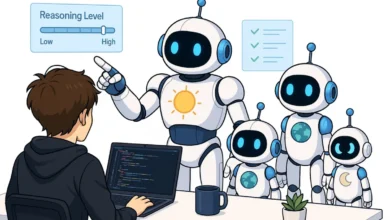
Beyond the Token Crisis: Why the AI Industry is Abandoning Chain-of-Thought for Latent Reasoning


The artificial intelligence sector has reached a critical economic and architectural crossroads. For years, the prevailing strategy for enhancing large language model (LLM) performance on complex logic, mathematics, and coding tasks relied on Chain-of-Thought (CoT) prompting and fine-tuning. This paradigm forced models to articulate step-by-step reasoning explicitly in human-readable text before generating a final answer. While this approach unlocked unprecedented capabilities, it has catalyzed a severe return-on-investment (ROI) dilemma characterized by skyrocketing compute bills, inflated memory usage, and crippling inference latency.
Recent industry developments highlight the unsustainability of current token expenditures. Reports indicate that Uber exhausted its annual AI budget within months, prompting a strategic overhaul of its agentic workflows. Simultaneously, Meta implemented strict caps on internal AI compute spend, and Amazon decommissioned its internal AI leaderboard, which had previously incentivized engineers to generate high volumes of LLM tokens. If major technology firms with immense capital reserves are encountering severe budgetary friction, the broader enterprise ecosystem faces an even steeper financial barrier to scalable deployment.
The root cause of this fiscal strain is the autoregressive nature of transformer architectures. Generating intermediate text tokens requires models to calculate probability distributions across vast vocabularies sequentially, consuming substantial memory bandwidth and slowing inference speeds. Consequently, the AI community is actively re-evaluating the foundational assumptions of machine reasoning, pivoting away from verbose text generation toward internal, continuous vector computations known as latent reasoning.
The Pragmatic Hack: The Rise and Limits of Chain-of-Thought
To understand the current industry shift, one must examine how CoT became an industry standard. When autoregressive transformers dominated natural language processing, researchers discovered that instructing models to "think step-by-step" significantly improved performance on multi-step problems. This technique required no structural modifications to existing neural network architectures. It scaled predictably with additional inference-time compute and offered human operators a transparent, text-based trace of the model’s logic.
However, a growing body of academic research suggests that the AI community has fallen into a cargo cult mentality, mistakenly equating the generation of expensive intermediate text tokens with genuine cognitive processing. A prominent position paper by Arizona State University Professor Subbarao Kambhampati and his research team systematically dismantled the assumption that text traces reflect true algorithmic generalization.
The researchers demonstrated that intermediate tokens frequently function as a structural constraint—a forced mimicry of human-like output formats—rather than a reliable execution trace. Empirically, models frequently arrive at correct conclusions through flawed, incoherent, or fabricated reasoning steps. Conversely, models can generate flawless logical progressions yet output incorrect final answers. This decoupling proves that an LLM’s internal computational state does not consistently track with the text it prints.
Further research into complex planning tasks reveals that CoT gains are often brittle outside narrow training distributions. Rather than teaching models general, repeatable procedures, CoT frequently induces prompt-specific behaviors that trigger error accumulation as reasoning chains lengthen. Because each generated token depends on the absolute accuracy of preceding tokens, a single logical deviation early in the text chain compromises the entire execution path. In certain out-of-distribution scenarios, forcing a model to generate explicit CoT traces actively degrades accuracy compared to direct inference.
The Financial and Technical Toll on Enterprise Infrastructure
Beyond cognitive limitations, the technical debt of CoT is staggering. Autoregressive text generation throttles inference speeds because models must process vocabulary spaces word-by-word. Long reasoning chains congest limited context windows with redundant prose, driving up memory footprints and increasing latency.
During post-training, models memorize sprawling, human-readable reasoning chains rather than extracting the fundamental mathematical structures of logic. This practice inflates parameter counts and demands massive hardware infrastructures, directly fueling the enterprise infrastructure budget crisis. Organizations deploying agentic systems find that multi-agent architectures compound these inefficiencies, as multiple LLMs pass verbose text strings back and forth, multiplying token consumption exponentially.

The Latent Solution: Continuous Thought and Vector Recursion
To escape the token-cost trap, researchers are pioneering alternative mechanisms that allow models to reason entirely within latent space. In neural networks, words are converted into complex numerical vectors. Standard transformers pass these vectors through hidden layers, translate them into text tokens, and repeat the cycle. Latent reasoners eliminate the intermediate text-translation phase, allowing the model to loop over problems internally by manipulating continuous vector representations directly.
This architectural shift is exemplified by Meta’s exploration of the "Chain of Continuous Thought" (the Coconut paradigm), which demonstrates that models can perform breadth-first searches entirely within hidden layers prior to emitting text. Similarly, AI startup Sapient Intelligence introduced the Hierarchical Reasoning Model (HRM) and HRM-Text, abandoning token-by-token reasoning in favor of a dual-timescale loop operating in latent space.
HRM decouples strategy from execution: a slow, abstract planning layer sets problem parameters, while a rapid computation layer executes recursive loops within the continuous representation space. By avoiding the autoregressive text-decoding bottleneck during the reasoning phase, HRM-Text achieved competitive scores on benchmarks like MATH and GSM8K using a compact one-billion-parameter model. Because sprawling CoT data was filtered out, the foundation model was trained from scratch for approximately $1,500 on 40 billion tokens, representing a stark contrast to conventional multi-million-dollar training runs.
Parallel efficiency gains are emerging in multi-agent orchestration. A collaborative study from researchers at the University of Illinois Urbana-Champaign (UIUC) and Stanford University introduced RecursiveMAS, a framework designed to mitigate multi-agent token exhaustion. Instead of exchanging text prompts, agents utilize a specialized module called "RecursiveLink" to transfer continuous latent embeddings directly.
In experimental evaluations, RecursiveMAS delivered an 8.3% accuracy improvement on complex orchestration tasks, a 2.4-fold increase in inference speed, and a 75.6% reduction in total token usage. By performing internal reasoning via recursive loops of hidden states rather than generating intermediate text, individual agents achieved unprecedented computational efficiency.
The Black Box Dilemma and Future Outlook
Despite superior performance and cost efficiency, latent and recursive reasoning architectures introduce a formidable operational challenge for production-grade applications: zero visibility.
While text-based Chain-of-Thought allowed human operators to audit a model’s step-by-step logic and debug failure points, latent reasoning confines computation to opaque multi-dimensional vector spaces. For safety-critical domains such as healthcare, finance, and legal compliance, the inability to inspect intermediate reasoning steps creates a severe auditing barrier.
Consequently, industry analysts predict that early-stage latent models will primarily serve as specialized execution engines integrated within hybrid architectures. While they excel at structured, deterministic tasks like coding and mathematical problem-solving, open-ended natural language generation and contextual knowledge retrieval will likely require continued reliance on supervised textual interfaces.
As enterprises demand sustainable AI economics, the industry’s transition away from verbose token generation marks the beginning of a profound architectural evolution. Resolving the tension between computational efficiency and operational transparency will define the next generation of enterprise artificial intelligence deployment.