The computer graphics, visual effects, and game development industries move at a blistering pace, with major flagship software releases frequently dominating headlines across trade publications and developer forums. However, beneath the noise of marquee product launches lies a robust ecosystem of specialized utility plugins, incremental engine updates, and minor version rollouts that are just as vital to everyday production pipelines. For many mid-sized studios and independent creators, these targeted updates often provide the exact feature fixes, performance optimizations, or hardware compatibility patches needed to hit tight project deadlines.
To bridge this information gap, this comprehensive round-up examines several notable software updates released across the digital content creation (DCC) landscape that did not receive standalone feature coverage last week. Focusing on key tools across animation management, GPU rendering, and real-time engine technology—specifically Animcraft 6.0, OctaneRender 2026.5, Radeon ProRender for Blender 3.7, and Unigine 2.22—this analysis explores how these developments impact professional workflows, hardware adoption, and pipeline efficiency.
Animcraft 6.0 Introduces Next-Generation AI Rigging and Animation Systems
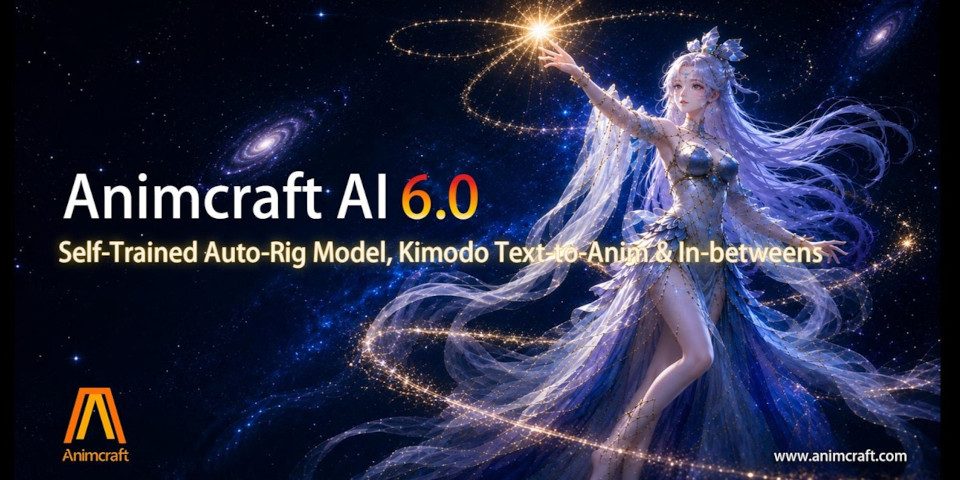
In the realm of character animation and asset management, Basefount has officially launched Animcraft 6.0. Known throughout the industry as a specialized, software-agnostic solution for constructing and organizing centralized animation libraries, Animcraft bridges the gap between disparate DCC applications like Autodesk Maya, Blender, and proprietary game engines. Traditionally, studios struggled with transferring animation data cleanly across varying character rigs without tedious manual cleanup or complex retargeting setups.
With version 6.0, Basefount addresses these historical pipeline bottlenecks by introducing sophisticated artificial intelligence-driven rigging and animation systems. These newly integrated AI capabilities are designed to automatically analyze character geometry, map skeletal structures intelligently, and streamline the retargeting process with unprecedented accuracy. By leveraging machine learning models trained on vast kinematic datasets, the software can drastically reduce the hours technical artists spend on skin weighting and skeleton setup.
Priced independently from the core application to give studios flexible scaling options, the AI toolset in Animcraft 6.0 reflects a broader industry trend toward AI-assisted technical direction. As pipelines grow increasingly complex, tools that automate repetitive rigging tasks allow smaller teams to compete with larger facilities by accelerating character turnaround times. Pricing and system requirements for the core software remain consistent with the previous version 5.0 release, ensuring a smooth transition for existing enterprise subscribers looking to test the new AI modules in their active productions.
OctaneRender 2026.5 Expands Hardware Support for Mobile Workstations
On the rendering front, Otoy has released OctaneRender 2026.5, marking another stable iteration of its industry-standard GPU production renderer. OctaneRender has long been celebrated for its unbiased, physically correct spectral rendering engine, which utilizes NVIDIA CUDA technology to deliver real-time feedback and photorealistic path tracing for high-end visual effects and architectural visualization.
The primary headline for the 2026.5 release is its day-one support for the RTX Spark, NVIDIA’s highly anticipated next-generation "superchip" engineered specifically for high-performance laptops and mobile workstations. As remote work and hybrid studio environments become standard practice across the media and entertainment sector, the demand for desktop-class rendering power in mobile form factors has reached an all-time high. The integration of RTX Spark support ensures that digital artists working on location or from home offices can harness advanced ray-tracing cores, AI denoising hardware, and massive memory bandwidth without being tethered to fixed tower workstations.
Otoy continues to maintain its steady release cadence, pushing iterative updates that prioritize hardware synergy. By ensuring that its rendering architecture instantly adapts to bleeding-edge silicon, Otoy allows production houses to future-proof their hardware investments. System requirements and subscription pricing structures for OctaneRender 2026.5 remain unchanged from the preceding 2026.4 release, keeping the upgrade path frictionless for current license holders.
Radeon ProRender for Blender 3.7 Maintains Compatibility
AMD continues its long-term support for open-source pipelines with the release of Radeon ProRender for Blender 3.7. Designed as a free, physically based GPU rendering plugin, Radeon ProRender enables artists to leverage OpenCL and Vulkan standards across various hardware vendors, though its primary optimizations are tailored for AMD Radeon graphics cards.
Version 3.7 arrives primarily as a maintenance and compatibility update, ensuring seamless integration with Blender 5.2, the latest iteration of the open-source 3D creation suite. Industry observers note that while AMD is actively maintaining the plugin to ensure compatibility with modern host applications, the software has not received a major feature expansion since the release of version 3.6 back in 2023.
Despite the lack of sweeping feature additions, the continued upkeep of Radeon ProRender remains significant for budget-conscious studios, educational institutions, and independent creators who rely on AMD hardware ecosystems. Compiled binaries for version 3.7 are available free of charge exclusively for Windows environments, while the underlying source code remains accessible under the permissive Apache 2.0 license via GitHub. This open-source availability allows technical pipelines to customize and compile the renderer directly into proprietary production frameworks.
Unigine 2.22 Strengthens Cinematic and Animation Toolsets
Rounding out the week’s notable updates is Unigine 2.22, the latest iteration of Unigine’s real-time 3D engine. Historically recognized as an exceptionally powerful engine for industrial simulation, digital twins, and large-scale maritime or aerospace visualization—largely due to its unmatched planetary-scale rendering capabilities and massive coordinate precision—Unigine has faced historical criticisms regarding its suitability for traditional entertainment and cinematic game development.
Version 2.22 directly confronts this limitation by overhauling and expanding its native animation toolset. The standout addition in this release is Sequencer, a brand-new timeline-based cinematic creation tool implemented directly within the Unigine Editor. Sequencer empowers technical artists and directors to block out complex camera movements, trigger in-engine events, and choreograph character performances without needing to export scenes to external digital content creation software.
Additionally, the release significantly enhances the capabilities of the Unigine Animation Graph, providing developers with finer control over state machines, blending, and procedural motion in real time. These improvements signal a strategic shift for the platform, positioning Unigine not only as a titan of industrial simulation but as a viable, high-performance alternative for game developers and virtual production studios seeking robust real-time rendering pipelines. Pricing and system requirements for Unigine 2.22 remain aligned with the established framework set during the 2.21 release cycle.
Implications and Industry Outlook
The software releases and updates documented throughout September 2026 highlight a mature digital content creation market where developers are focusing heavily on workflow integration, hardware optimization, and targeted problem-solving. Whether it is Basefount integrating AI into character rigging to eliminate technical friction, Otoy adopting next-generation mobile silicon to empower remote artists, AMD maintaining open-source rendering pipelines for Blender, or Unigine expanding its cinematic toolset to court entertainment developers, the overarching goal remains consistent: reducing friction in the creative pipeline.
As studios navigate tighter production budgets and compressed delivery schedules, the adoption of specialized tools that automate tedious tasks or adapt seamlessly to new hardware architectures will dictate competitive advantage. Developers and technical directors are encouraged to review the official release notes and changelogs linked through respective vendor portals to evaluate how these iterative updates can be strategically integrated into their upcoming pipelines.
Related posts: