Arturia Pure SUB Review: The Soft Synth Laser-Focused on Massive 808 and Reese Bass Lines

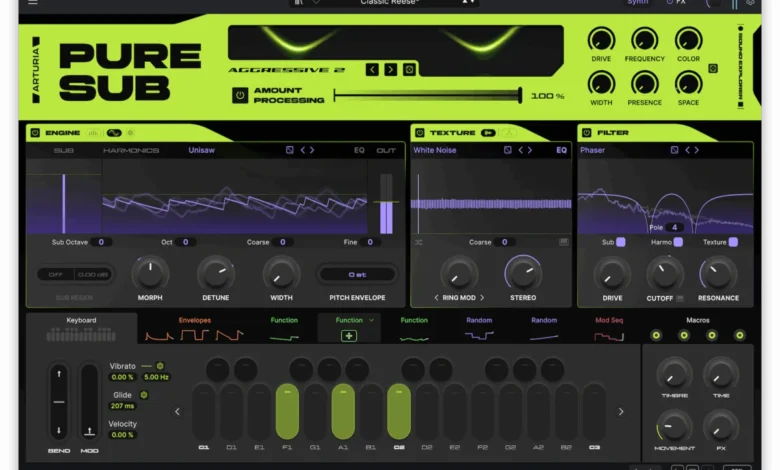
In the modern landscape of digital audio workstations and virtual studio technology, software instrument developers increasingly favor hyper-specialized tools over monolithic workstations. While powerhouse synthesizers like Native Instruments Massive, Xfer Records Serum, and Arturia’s own Pigments remain staples of electronic music production, producers often find themselves pressed for time when designing complex synth patches from scratch. Addressing this shift toward rapid workflow efficiency, French audio software developer Arturia has introduced Pure SUB, a monophonic soft synth explicitly engineered to tackle the fundamental architecture of low-end frequencies—specifically targeting the heavy requirements of 808 sub-basses and Reese bass lines.

Priced accessibly at a standard €79, with an introductory promotional sale bringing it down to €49, Pure SUB enters a competitive software market currently dominated by expansive modular ecosystems and premium multi-engine bass plugins. Designed with a laser-focused objective, the plugin eliminates the distractions of multi-layered polyphonic sound design, offering producers an optimized, streamlined environment for dialing in chest-rattling low-end in genres such as jungle, UK garage, dubstep, and various 140-bpm underground styles.

Architectural Breakdown: Sound Generation and Multi-Tier Processing
Despite its singular focus on sub-heavy frequencies, Pure SUB is far from a simplistic utility plugin. It features a sophisticated architecture divided into distinct processing stages, providing producers with granular control over sound generation, harmonic content, and noise textures.

At the core of the monophonic synth engine lies a single primary oscillator split into three distinct chambers: Sub, Harmonics, and Texture. Each section operates independently, allowing users to apply targeted processing before the signals converge at the filter and master output stages.

The Sub chamber manages the foundational sine wave, which is essential for anchoring any low-end heavy mix. Producers can adjust the volume, select octave settings ranging from 0 to -2, and determine custom routing paths. Rather than forcing producers to generate a separate sine sub track within their digital audio workstation—a common mixing workaround—Pure SUB allows the sub-frequency to bypass certain processing blocks or route directly to the master output after the filter and effects stages.

Moving into the mid-bass frequency range, the Harmonics section deploys two distinct sound engines: Pressure and Reese. The Pressure engine utilizes an additive synthesis model tailored for solid 808s and punchy sub-basses. It features an advanced editor screen that enables users to morph between three additive states, utilizing preset waveforms or custom hand-drawn harmonic layouts. Meanwhile, the Reese engine utilizes an aggressive wavetable architecture, offering a wide selection of factory tables alongside user import capabilities. Both engines incorporate standard sound-shaping controls, including morphing, detuning, stereo width adjustments, and an onboard equalizer.

The final generation stage, Texture, acts as a dedicated noise module. Acknowledging contemporary bass production trends that favor textured, aggressive top-ends over pristine sine waves, the module combines a virtual analog noise generator with a curated bank of noise samples, alongside an option to import custom audio files.

Filtering, Modulation, and Workflow Integration
To shape these generated waveforms, Arturia has integrated a flexible filter section drawing inspiration from its flagship soft synth, Pigments. Featuring acclaimed filter models—including aggressive distortion-oriented circuits like Rage—the filter allows users to independently toggle the Sub, Harmonics, and Texture stages on or off, ensuring that the fundamental sub-frequency remains clean while mid-bass layers undergo heavy saturation and filtering.

Users familiar with Pigments will instantly recognize Pure SUB’s modulation architecture. The software employs Arturia’s signature drag-and-drop modulation system, complemented by real-time animated graphics that visualize the rate, shape, and depth of modulation sources. The modulation matrix accommodates a pitch envelope positioned strategically at the front of the envelope page for rapid 808 creation, alongside dedicated amplitude and modulation envelopes, function generators, random generators, voice modulators, step modulators, and four assignable macro controls.

Comprehensive Onboard Effects Processing
Pure SUB defies expectations for a specialized utility plugin by incorporating a robust effects suite split across two dedicated interfaces: the Sub Processor and the main FX page.

The Sub Processor operates as a specialized strip located directly on the main interface, featuring dedicated knobs for drive, frequency, color, width, presence, and space, balanced by a wet/dry processing amount slider. When modulated via the internal function generators, this section delivers immediate tonal transformation.

For broader processing, the comprehensive FX rack provides slots for up to 17 distinct effect units drawn from Arturia’s established catalog. Producers can reorder effects via a drag-and-drop rack interface, utilizing tools such as multiband compression (including Arturia’s variant of the popular OTT compression algorithm), distortion, flangers, and reverbs to push the sound design to its limits.

Practical Application: Crafting 808s and Reese Basses
In practical application, Pure SUB streamlines the traditionally labor-intensive process of low-end sound design. When constructing a modern 808 patch, producers can select the Pressure additive engine, choose from factory presets like 808 6, and dial in a dedicated pitch envelope amount—such as 24 semitones—to achieve the characteristic punchy transient and sustained sub decay typical of modern hip-hop and electronic music production. By routing white noise through a Rage distortion filter and layering the Sub Processor with multiband compression, producers can quickly achieve gritty, saturated bass tones without complex parallel routing.

Similarly, building a classic Reese bass utilizes the instrument’s wavetable Reese engine. By selecting custom wavetables, expanding the stereo width, detuning oscillators, and routing the cutoff through a bipolar function generator, producers can generate a wide, evolving mid-bass. Subsequent processing chains utilizing phasers, notch filters, and reverbs—combined with MIDI glide settings—yield professional-grade jungle and drum and bass textures out of the box.

Market Positioning and Industry Implications
Arturia’s strategic pricing for Pure SUB reflects a calculated approach to the plugin market. While competitors like UVI’s Rumble offer alternative bass synthesis solutions at a higher price point (around $199), Pure SUB’s standard retail price of €79—further reduced during its introductory promotional period—positions it as an exceptionally cost-effective investment for electronic music producers.

While purists might note that the instrument is optimized specifically for sub-bass duties rather than general-purpose polyphonic synthesis, its combination of targeted sound generation engines, advanced modulation, and extensive effects routing delivers immense value. For producers working extensively within bass-driven genres, Pure SUB offers a streamlined, inspiring, and financially accessible alternative to complex modular patches, cementing its place as a formidable addition to the modern producer’s toolkit.