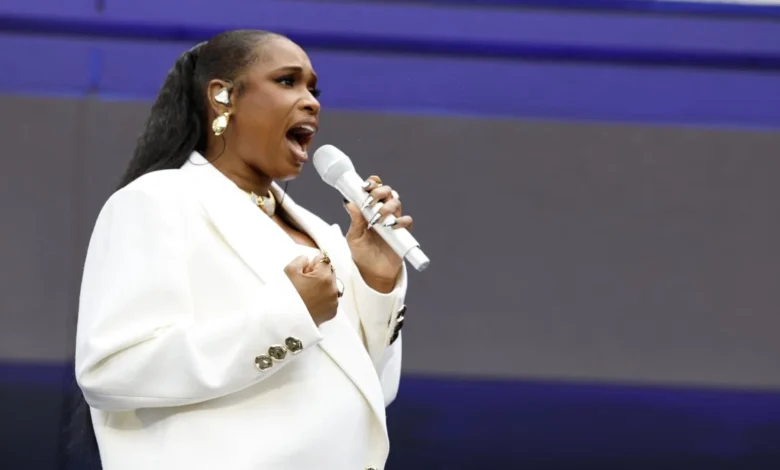
The highly anticipated FIFA World Cup final, slated for Sunday, July 19, at New York New Jersey Stadium (commonly known as MetLife Stadium) in East Rutherford, New Jersey, is set to feature an unexpected cultural moment: a performance of "The Star-Spangled Banner" by Grammy Award-winning artist and talk show host Jennifer Hudson. This announcement, made by FIFA on July 14, has ignited a considerable debate among football fans globally, as the United States men’s national team did not qualify for the final match, which will see Spain face Argentina. The decision to include the American anthem in a ceremony preceding a final without the host nation’s team has been met with both confusion and criticism, casting a spotlight on FIFA’s broader commercial strategies and the evolving intersection of sports and entertainment on a global stage.
The Unconventional Anthem Performance and Immediate Reactions
Jennifer Hudson’s "special rendition" of the U.S. national anthem is scheduled to take place during the pre-game ceremony at 1:30 p.m. ET, 90 minutes before the official kickoff. This performance is distinct from the traditional protocol where only the national anthems of the two competing nations are played immediately before the match. FIFA’s explanation for Hudson’s inclusion centers on the fact that the final is being held on American soil, framing the performance as a tribute to the host country. However, this rationale has not fully appeased a segment of the global football community, particularly given that the United States is co-hosting the tournament with Canada and Mexico, yet only the U.S. anthem is scheduled for this special presentation.
Social media platforms quickly became a forum for fans to voice their bewilderment and displeasure. Many questioned the precedent this sets, with some advocating for the inclusion of Canadian and Mexican anthems if the intent is to honor host nations. Others viewed it as an overt attempt to inject American cultural elements into a global sporting event, potentially diluting the traditional European and South American footballing ethos that has long defined the World Cup. The sentiment ranged from simple confusion ("Why is the American anthem being performed at a game that does not include the United States?") to more pointed critiques about the "Americanization" of the tournament.
FIFA’s Strategic Vision: Tapping into the American Market
The decision to feature "The Star-Spangled Banner" by a prominent American artist, despite the U.S. team’s absence from the final, is not an isolated incident but rather a calculated move within FIFA’s overarching strategy to significantly expand its footprint and revenue in the lucrative North American market. This strategic thrust is underscored by ambitious financial targets: FIFA expects to generate a record $13 billion during the current World Cup cycle (2023-2026). A substantial portion of this projected revenue is anticipated to come from the United States, a market traditionally less saturated with football fandom compared to other global regions but possessing immense commercial potential.
The World Cup 2026, uniquely co-hosted by three nations, represents an unprecedented opportunity for FIFA to cement football’s status as a major sport in North America. The U.S., with its vast consumer base, developed infrastructure, and significant media market, is central to this vision. By curating a pre-game experience that resonates with American audiences, FIFA aims to capture the attention of casual viewers and those who may not typically follow soccer, thereby maximizing viewership, advertising revenue, and merchandise sales.
Early indicators suggest this strategy is yielding positive results. Fox’s group-stage broadcasts for the current World Cup cycle averaged more than 5 million viewers in the U.S., nearly doubling the audience for the same stage in 2022. Furthermore, the U.S. team’s matches drew significantly larger Spanish-language audiences on Telemundo and Peacock than during the previous World Cup, highlighting a growing and diverse viewership base within the country. In this context, Jennifer Hudson’s performance can be interpreted as a direct appeal to this expanding American audience, keeping them engaged even after their national team’s exit from the competition.
A Precedent from 1994: The Star-Spangled Banner’s Previous World Cup Appearance
While the current announcement has sparked debate, the concept of performing the U.S. national anthem at a World Cup hosted on American soil, even without the U.S. team in the final, is not entirely unprecedented. When the United States last hosted the men’s World Cup in 1994, saxophonist Kenny G performed "The Star-Spangled Banner" during the closing ceremony. This performance took place before Brazil and Italy contested the final at the Rose Bowl in Pasadena, California.
This historical context provides a degree of justification for FIFA’s current decision, demonstrating that a similar ceremonial inclusion has occurred previously. However, the scale of commercialization and global media scrutiny has intensified dramatically since 1994. The rise of social media means that every decision by a major sporting body like FIFA is immediately subjected to widespread public debate and analysis, making the current reaction more pronounced than it might have been three decades ago. The memory of the 1994 event, while offering a historical parallel, does not entirely quell the contemporary concerns about market-driven cultural shifts within the tournament.
The Extravagant Halftime Show: Further ‘Americanization’ Concerns
Beyond the pre-game anthem, FIFA’s commitment to entertainment-heavy programming is most vividly demonstrated by the introduction of an elaborate halftime show for the World Cup final – a first in the tournament’s history. This 11-minute spectacle, curated by Coldplay frontman Chris Martin, boasts an star-studded lineup including Madonna, Shakira, BTS, and Justin Bieber as headliners. The performance will also feature Burna Boy, conductor Gustavo Dudamel, the PS22 Chorus with Coldplay, and characters from beloved children’s franchises Sesame Street and The Muppets. Adding to the celebrity quotient, Tom Cruise is scheduled to make a special, though unspecified, appearance during the pre-game events.
This extended halftime show, reminiscent of the Super Bowl’s iconic halftime productions, has drawn considerable criticism from traditional football fans. Many view it as another clear attempt to import the structure and entertainment ethos of American sports into the World Cup, a move they argue detracts from the purity and flow of the football match itself. Concerns have been raised that such lengthy entertainment breaks could disrupt the teams’ rhythm, affect player conditioning, and prioritize commercial spectacle over sporting integrity.
The performance is intended to support the FIFA Global Citizen Education Fund, an initiative raising money to expand access to education and soccer programs for children worldwide. While the charitable aspect is commendable, for many purists, it does not outweigh the perceived "Americanization" of the sport’s most prestigious event. This sentiment aligns with earlier complaints during the tournament about entertainment-heavy opening ceremonies and even hydration breaks, which some viewers believe are strategically timed to create additional television advertising opportunities. The cumulative effect of these entertainment-focused additions strengthens the argument that FIFA is prioritizing commercial gain and audience expansion, particularly in the U.S., over strict adherence to footballing traditions.
The Broader Implications: Balancing Tradition and Commercial Imperatives
The current scenario at the World Cup final highlights a crucial tension within global sports organizations like FIFA: the delicate balance between preserving established traditions and embracing commercial imperatives for growth. The World Cup, as the most watched single sporting event globally, holds immense cultural significance for billions. For many, its appeal lies in its unadulterated focus on the game, the passion of the fans, and the athletic prowess of the teams. The introduction of elements perceived as "American" or overly commercialized risks alienating a core segment of its traditional audience.
However, from FIFA’s perspective, the decision is a pragmatic one. To achieve its ambitious revenue targets and ensure the continued global expansion of football, particularly in emerging markets like the U.S., it must appeal to a broader demographic. This involves integrating elements that are familiar and attractive to these new audiences, even if it means tweaking long-held customs. The investment in celebrity performances, extended halftime shows, and strategic marketing is designed to transform the World Cup from a niche sporting event for enthusiasts into a mainstream entertainment spectacle capable of capturing a diverse viewership.
The World Cup 2026, with its unprecedented co-hosting arrangement and the strategic emphasis on the North American market, could serve as a blueprint for future major sporting events. The success or failure of FIFA’s current approach in balancing commercialization with tradition will have significant implications for how global sports tournaments evolve in an increasingly interconnected and entertainment-driven world. It raises fundamental questions about the identity of the World Cup: Is it primarily a football tournament, or is it evolving into a global cultural festival where sport is but one component of a larger entertainment package?
How to Watch the World Cup Final and Closing Ceremony
For those eager to witness both the pre-game spectacle and the highly anticipated final match, here are the details:
- Teams: Spain vs. Argentina
- Date: Sunday, July 19
- Venue: New York-New Jersey Stadium (MetLife Stadium), East Rutherford, New Jersey
- Closing Ceremony/Pre-Game Event Start: 1:30 p.m. ET
- Match Kickoff: 3:00 p.m. ET
Television and Streaming Coverage:
- English-language coverage: Will be broadcast on Fox. Streaming options include Fox One and the Fox Sports app.
- Spanish-language coverage: Will be available on Telemundo. Streaming access is provided via Peacock, which has confirmed live streams for all 104 matches of the tournament, including the final, in Spanish.
As the world tunes in, the performance of "The Star-Spangled Banner" by Jennifer Hudson, alongside the elaborate halftime show, will not just be a prelude to a football match; it will be a focal point in an ongoing discussion about the future direction of the FIFA World Cup and the intricate interplay between global sport, national identity, and commercial entertainment. The American team may be out of the tournament, but the American audience, and the immense financial potential it represents, are undeniably central to FIFA’s game plan.