GrowFrame Offers Independent Creators a Digital Archive for Long-Term Artistic Projects

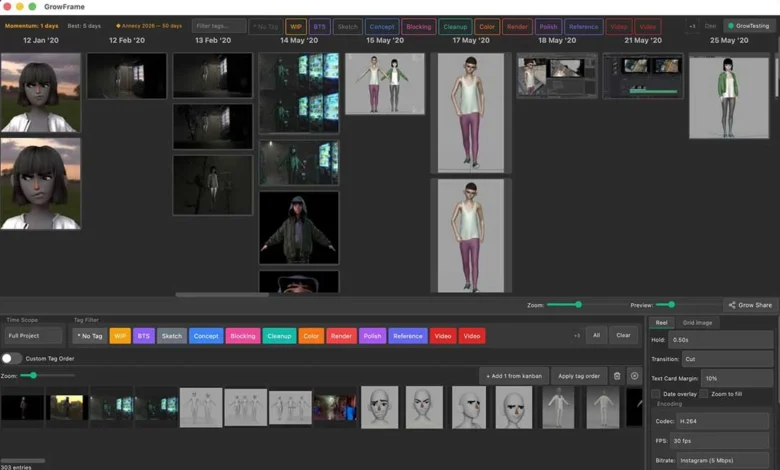
In an era defined by rapid-fire content generation and the burgeoning influence of generative artificial intelligence, the creative process—particularly the arduous, multi-year journey of independent animation and fine art—often goes undocumented. Professional production tracking tools, such as Autodesk’s Flow Production Tracking, are designed for studio-scale operations, leaving individual creators and small teams without an efficient way to catalog their progress. To address this gap, Miquel Campos, the architect behind the renowned mGear framework, has released GrowFrame, a desktop-based application tailored specifically to the needs of the solitary artist.
The Philosophy of the Slow Craft
GrowFrame is fundamentally a response to the "instant-gratification" culture currently dominating digital media. While many software developers are pivoting toward cloud-integrated, AI-assisted workflows, Campos has taken a decidedly contrarian approach. Developed out of his small studio in Tokyo, mcsGear GK, GrowFrame serves as a localized, private vault for the incremental milestones that define a passion project.
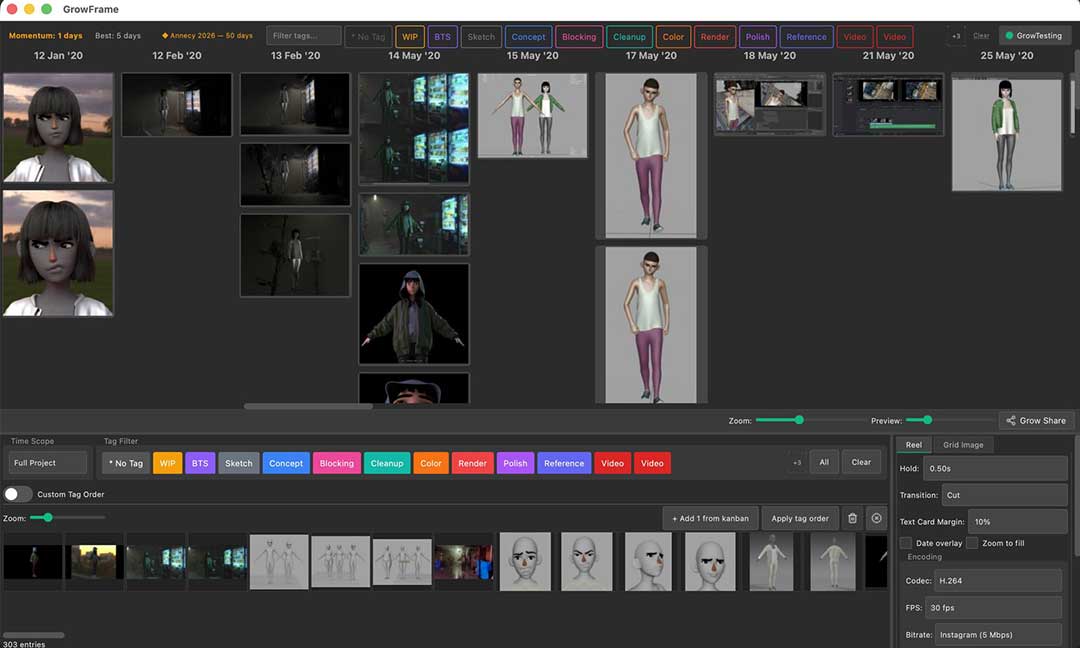
Campos, whose work with mGear has long been a staple in game development and real-time animation pipelines, conceived the app while struggling to track his own long-form animated short film. The challenge for many independent animators is not merely the technical execution, but the psychological hurdle of maintaining momentum over a project that may span years. By providing a visual timeline of a user’s daily output—whether that involves raw sketches, rendered frames, animation tests, or photographic documentation of physical sculptures—GrowFrame transforms the abstract passage of time into tangible proof of progress.
A Technical Overview of the Workflow
Unlike industry-standard project management suites that rely on complex metadata, task assignment, and cloud-based synchronization, GrowFrame prioritizes a "local-first" philosophy. The application functions as a Kanban-style visual tracker, allowing users to ingest various media formats into a chronological repository. This structure is intended to solve the "motivation deficit" inherent in long-term creative work. When an artist can scroll back through years of iterations, the accumulation of effort becomes a quantifiable asset rather than an invisible, taxing process.
One of the application’s most utilitarian features is its automated export functionality. Recognizing that creators often lose hours each week repurposing work for social media and portfolio updates, GrowFrame includes tools to compile sequences of work into reels optimized for multiple social platforms. By automating this administrative burden, the software effectively returns creative time to the artist.
The Shift Toward Permanent Licensing
Perhaps the most significant departure from current software trends is the pricing and distribution model adopted by GrowFrame. In an industry where "Software as a Service" (SaaS) and monthly subscription models have become the standard, Campos has opted for a one-time purchase, perpetual license.
The software explicitly avoids telemetry and cloud-based data storage, focusing instead on data sovereignty. The only external communication the application performs is for initial license activation. This design choice aligns with a growing sentiment among professional artists who are increasingly wary of cloud-dependency, data privacy, and the risk of software becoming inaccessible should a subscription lapse or a service provider pivot its business model.
Contextualizing the Need for Creative Documentation
The emergence of GrowFrame occurs against a backdrop of shifting paradigms in the creative arts. Since 2022, the rapid advancement of Large Language Models (LLMs) and image-generation tools has fundamentally altered the perceived value of digital imagery. The speed at which these tools can generate high-fidelity assets has led to an oversaturation of feeds, often leaving human-made work buried.
Campos’s perspective is rooted in the intrinsic value of the "hand-made." He argues that while AI has its place as a technological advancement, the long-term, slow-burn creative work represents a form of human expression that is arguably becoming more, not less, valuable as machine-generated content proliferates. GrowFrame serves as an infrastructure for that human-centric work, ensuring that the "messy" middle stages of a project are preserved rather than discarded.
Educational Applications and Beta Integration
While designed for the individual professional, the application has found an unexpected secondary market in academia. Animation and fine arts programs have increasingly looked for ways to teach students about the "pipeline" of professional production without requiring the complex overhead of enterprise-grade software.
During the beta phase, several educational institutions began testing GrowFrame as a tool for students to document their thesis projects. For a student, the ability to present a comprehensive history of their artistic development—showing the evolution from a loose concept to a final render—is an invaluable component of their professional portfolio. This has led to the implementation of educational pricing, aiming to lower the barrier for entry for students who are just beginning to manage their own multi-year creative journeys.
Strategic Implications for Independent Studios
For an independent studio or a solo practitioner, the primary overhead is often not just the cost of hardware and software, but the "hidden cost" of management. When a single person is acting as the producer, animator, rigger, and publicist, any tool that reduces cognitive load is significant.
Analysts note that the "indie-tooling" sector has historically been underserved. While massive suites are capable, they are often prohibitively expensive and overly complex for a one-person team. GrowFrame’s success, should it mirror the community adoption seen by the mGear framework, could signal a wider trend in software development: the return of specialized, local, and permanent tools designed for the "prosumer" and independent professional.
By focusing on a niche—the long-term, manual creative project—Campos is positioning his product not as a competitor to enterprise tools, but as an essential utility for those whose work process is fundamentally incompatible with the fast-paced, high-turnover requirements of modern project management software.
The Future of the GrowFrame Ecosystem
As GrowFrame exits its beta phase, its trajectory will likely be determined by its ability to integrate with existing creative suites. While the current version excels at visual documentation, the potential for expansion into version control and deeper asset integration remains. However, given the developer’s commitment to simplicity and privacy, future updates are expected to prioritize stability and user experience over feature bloat.
The release of GrowFrame serves as a reminder that the creative industry remains fragmented. As large studios continue to consolidate their workflows around integrated, proprietary platforms, the individual creator is left to navigate a landscape that prioritizes scale over craft. GrowFrame represents a deliberate choice to support the latter.
For those interested in exploring the tool, the application is currently available via its official portal, with specific licensing tiers for both independent professionals and educational institutions. Whether it succeeds in becoming a standard for independent artists will depend on how many practitioners recognize the value of documenting their "slow craft" in a world that increasingly demands everything to be instantaneous.
In the final analysis, GrowFrame is more than just a tracking app; it is a defensive tool for the human creative. By making the unseen work of the artist visible, it provides a necessary counter-narrative to the idea that time is merely a commodity to be minimized, rather than a crucial element of the artistic process itself. As the divide between AI-assisted production and traditional manual craft continues to widen, tools that validate the effort, time, and human history of a piece of work will likely become essential components of the modern artist’s toolkit.