YouTube Q3 2026 Earnings Show Ad Growth Moderation Alongside Explosive Expansion in Subscriptions, Connected TV, and Creator E-Commerce

Alphabet Inc., the parent company of Google and YouTube, released its financial results for the third quarter of 2026, revealing a complex and shifting landscape for the world’s leading online video platform. While YouTube’s core advertising revenue experienced a modest deceleration compared to previous quarters, the platform demonstrated robust health in other vital areas. Most notably, subscription offerings surged past previous milestones, connected television (CTV) viewing cemented its position as a primary revenue engine, and new e-commerce and artificial intelligence initiatives accelerated monetization opportunities for both the platform and its expansive creator ecosystem.
The financial data underscores a maturation of YouTube’s traditional revenue streams alongside the successful scaling of diversified business models. As consumer media consumption habits continue their definitive migration away from linear television toward digital and streaming alternatives, YouTube is positioning itself at the epicenter of this structural shift, utilizing technological integration and strategic partnerships to capture consumer attention and advertiser dollars alike.
Ad Revenue Growth Moderates While Subscriptions Surge
For the third quarter of 2026, YouTube generated $11.2 billion in advertising revenue. This figure represents a 9% year-over-year increase, reflecting a slight cooling trend when compared to the 13% growth rate reported during the second quarter of the year. Industry analysts suggest that while ad revenue growth has moderated, the sheer scale of the $11.2 billion quarterly intake indicates sustained advertiser demand, particularly as brands reallocate budgets toward digital video environments.
In tandem with advertising, YouTube’s subscription services experienced remarkable expansion, driving an 11% overall increase in Google’s aggregate subscription revenue. Combined figures for YouTube Music and YouTube Premium revealed that the services have collectively surpassed 150 million paying subscribers. This represents a massive leap from early 2024, when the subscription base crossed the 100 million threshold.
The rapid adoption of premium tiers is heavily anchored in changing domestic viewing habits. During Alphabet’s second-quarter earnings call in July, company executives highlighted a significant surge in Premium sign-ups among connected TV (CTV) households. As audiences increasingly bypass traditional cable and broadcast television in favor of YouTube’s living room experience, the value proposition of an ad-free viewing environment combined with integrated music streaming has resonated strongly with global consumers.
The Living Room Revolution and Connected TV Dominance
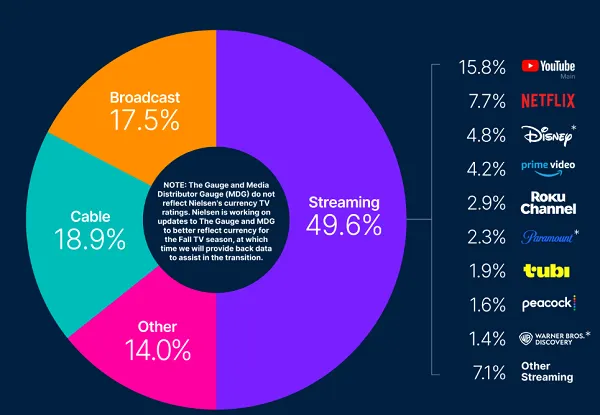
The traditional boundary between television and digital video has dissolved entirely, with YouTube emerging as the primary beneficiary of this transition. Data from Nielsen’s widely cited The Gauge report, published in August 2026, reaffirmed YouTube’s status as the top streaming platform in the United States, commanding the largest share of television screen time among all streaming services.
Capitalizing on this dominance, YouTube’s "Living Room" experience has evolved from a secondary viewing format into a primary financial pillar. During the accompanying Q3 earnings call, Google Chief Business Officer Philipp Schindler revealed that connected TV viewing now accounts for more than one-third of total YouTube advertising revenue. This structural shift has fundamentally altered how brands buy inventory on the platform, as living room viewers offer high-engagement environments comparable to, or exceeding, traditional television broadcasts.
Schindler also noted continued strength in small and medium-sized business (SMB) adoption of Google’s Demand Gen products, indicating that automated, multi-format advertising campaigns are effectively lowering the barrier to entry for smaller advertisers looking to leverage YouTube’s expansive reach.
Expanding the Creator Economy Through E-Commerce and Partnerships
Beyond traditional advertising and subscriptions, YouTube continues to aggressively build out its creator economy infrastructure, aiming to secure long-term loyalty from content producers by providing diverse revenue channels.

The YouTube Partner Program has expanded significantly, with more than 3 million creators now eligible to monetize their content. Concurrently, YouTube’s e-commerce initiatives are gaining structural momentum. More than 1.3 million channels are currently enrolled in the platform’s shopping program, transforming passive video viewing into active retail environments.
A major catalyst for this e-commerce expansion is a newly minted affiliate partnership with retail giant Amazon. Announced recently, the integration enables U.S.-based creators to directly tag Amazon products within their long-form videos, Shorts, and livestreams. By bridging the gap between content creation and seamless retail transactions, YouTube is opening up lucrative affiliate marketing streams for creators while offering brands an optimized path from discovery to purchase.
Artificial Intelligence Integration and Creative Tools
Artificial Intelligence remains a central strategic focus for Alphabet, with generative AI tools increasingly woven into the fabric of YouTube’s creation and advertising workflows. During the earnings briefing, executives emphasized that AI is being deployed both to optimize ad targeting for enterprise clients and to democratize high-level video production for everyday users.
Highlighting the sheer volume of content uploaded to the platform—surpassing 20 million videos daily—Schindler detailed how new generative AI features in YouTube Studio are streamlining the creative process. Innovations such as the conversational editing assistant in Shorts and YouTube Create are designed to reduce technical friction for content creators.
This push follows a series of strategic AI rollouts throughout 2026. In March, YouTube introduced an AI-powered "reimagine" option for Shorts, allowing viewers to generate alternative video variations based on existing creator clips. Additionally, platform trials of an "Extend with AI" feature have given creators the ability to seamlessly generate alternative video endings.
User reception to these capabilities appears overwhelmingly positive. A proprietary YouTube report published in mid-October 2026 revealed that 61% of individuals who have posted video content on the app over the past 12 months expressed a strong interest in utilizing AI tools to integrate themselves directly into video productions. While industry observers continue to debate the broader societal implications of synthetic media—often referred to colloquially as "AI slop"—empirical platform data suggests that YouTube’s targeted, creator-centric AI integrations are aligning closely with user demand.
Chronology of Key Milestones Leading to Q3 2026
To understand YouTube’s current financial and operational trajectory, it is instructive to examine the timeline of key developments leading up to the third quarter of 2026:
- Early 2024: YouTube crosses the milestone of 100 million combined Music and Premium subscribers globally.
- March 2026: The platform rolls out the AI-powered "reimagine" feature for YouTube Shorts, introducing generative video-remixing capabilities to general users.
- Mid-2026: Nielsen’s The Gauge reports confirm that YouTube maintains its position as the leading streaming platform in the United States by total TV viewing time.
- July 2026: During the Q2 earnings call, Alphabet executives report a major surge in connected TV Premium subscriptions as viewers increasingly treat YouTube as an alternative to traditional television.
- August 2026: Continued expansion of the YouTube Partner Program brings total eligible creators past the 3 million mark.
- September 2026: YouTube announces a landmark affiliate partnership with Amazon, allowing U.S. creators to tag products directly within video content and livestreams.
- Mid-October 2026: YouTube publishes data showing that 61% of recent active creators are eager to utilize generative AI tools for enhanced video creation.
- Late October 2026: Alphabet reports Q3 2026 results, showing $11.2 billion in ad revenue and a global subscription base exceeding 150 million users.
Broader Market Implications and Future Outlook
The financial disclosures and strategic updates from Alphabet’s Q3 2026 earnings report illustrate a platform successfully navigating the transition from a pure-play digital video site into a diversified media conglomerate.
The moderation in year-over-year ad revenue growth—from 13% in Q2 to 9% in Q3—suggests that while traditional banner and in-stream advertising remains foundational, future hyper-growth will likely be anchored in non-advertising verticals. The explosive trajectory of YouTube’s subscription business, which has added 50 million subscribers in less than three years to clear the 150 million mark, provides Alphabet with a reliable, high-margin recurring revenue stream that insulates the company against macroeconomic advertising fluctuations.
Furthermore, the dominance of the Living Room connected TV experience is reshaping digital media economics. By capturing over a third of its total ad revenue from big-screen viewing, YouTube is directly competing with, and increasingly displacing, traditional cable networks for premium brand marketing dollars. Combined with the rapid scaling of the Amazon affiliate e-commerce partnership and the widespread adoption of AI-driven creative tools, YouTube is constructing a resilient ecosystem designed to maximize user retention, creator monetization, and advertiser ROI well into the future.