RiverFlux Audio Unveils Bit Layer, A Powerful Free Multiband Bitcrusher Plugin For Advanced Lo-Fi Sound Design

The landscape of digital audio production has long embraced the aesthetic of imperfection. For decades, producers and sound designers have sought out ways to inject warmth, grit, and character into pristine digital recordings. Among the tools designed for this purpose, the bitcrusher stands out as a fundamental utility. By intentionally degrading audio signals through the reduction of bit depth and sample rate, these processors generate crunchy textures, gritty timbres, and distinct digital artifacts reminiscent of vintage samplers from the early days of digital audio. While most Digital Audio Workstations (DAWs) come equipped with stock bitcrushers, these built-in options often feature basic interfaces with limited routing capabilities. Addressing the demand for more granular control, boutique developer RiverFlux Audio has released Bit Layer, a sophisticated, completely free plugin that brings advanced multiband architecture, mid/side routing, and transient processing to the world of digital signal degradation.
Main Facts of the Release
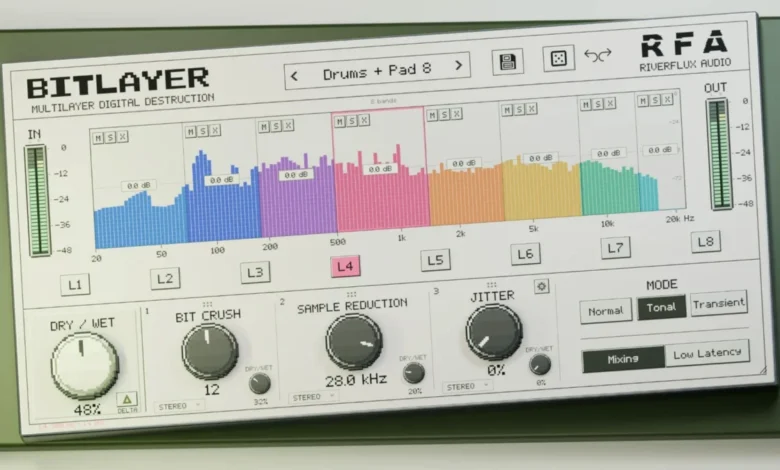
Bit Layer represents a significant step forward in the realm of free audio effects, offering features typically reserved for premium, paid-for VST plugins. Developed by RiverFlux Audio, the plugin provides up to eight independent layers of processing. Each layer is equipped with dedicated controls for bit depth, sample rate, and jitter, allowing users to fine-tune the exact nature of the digital distortion. Furthermore, these three core parameters can be freely reordered within the signal path, giving sound designers immense flexibility over how the degradation is calculated and applied.
In addition to its deep processing layers, Bit Layer incorporates comprehensive mixing controls per band, including mute, solo, gain, and dry/wet mix parameters. The plugin is available immediately for Windows, Linux, and macOS platforms, supporting modern plugin formats including VST3, CLAP, and AU. Crucially, RiverFlux Audio is offering the plugin completely free of charge, making advanced lo-fi sound design accessible to producers regardless of their budget.
The Evolution of Digital Degradation
The concept of bitcrushing is rooted in the technological limitations of early digital hardware. In the 1980s, samplers such as the E-mu Emulator and the Ensoniq Mirage operated at low bit depths (often 8-bit or 12-bit) and restricted sample rates due to memory constraints and processing power. This technical bottleneck produced a distinct sonic signature characterized by aliasing, quantization noise, and a warm, punchy harmonic distortion that heavily influenced the sound of early hip-hop, electronic music, and industrial genres.
As computing power advanced, audio fidelity reached unprecedented levels of clarity, prompting a counter-movement among producers who actively missed the sonic character of early digital gear. Software developers responded by creating emulations and dedicated bitcrusher effects. Early iterations were simple mathematical processors that stripped away data indiscriminately across the entire frequency spectrum.
Over time, developers recognized the need for greater control. Premium third-party plugins began introducing multiband processing, allowing users to target specific frequency ranges. However, many of these advanced tools remained locked behind paywalls, leaving bedroom producers and independent artists to rely on basic stock plugins like Ableton Live’s Redux, Logic Pro’s Bitcrusher, or Image-Line’s Fruity Squeeze. Bit Layer enters the market as a bridge between these two worlds, offering professional-grade routing features without the associated financial barrier.
Multiband Architecture and Surgical Sound Design
One of the standout features of Bit Layer is its multiband functionality. Traditional bitcrushers affect an entire incoming audio signal uniformly, which often leads to unwanted mud or excessive high-frequency harshness when applied to complex mixes or master buses. By dividing the frequency spectrum into multiple bands, Bit Layer enables producers to apply lo-fi textures selectively.
This capability transforms the bitcrusher from a blunt instrument into a surgical sound design tool. For instance, a producer working on a modern electronic track can apply heavy sample rate reduction and bit depth lowering to the high frequencies of a drum loop—crisping up hi-hats and top loops—while leaving the fundamental low-end energy of the kick drum completely untouched and pristine. Similarly, vocal tracks can benefit from subtle high-end grit that adds air and edge without introducing distortion to the critical mid-range frequencies where intelligibility resides.
Expanding Control: Mid/Side Routing and Transient Processing
Beyond frequency-based separation, Bit Layer extends its precision into the stereo field and the time domain through advanced routing options.
The inclusion of mid/side (M/S) routing across all three modules within each band allows users to treat the center of a stereo image differently from the outer edges. In practical terms, a producer can choose to crush the side channels of a synth pad or a stereo bus to create a wider, more diffused lo-fi atmosphere, while keeping the mid channel clean and centered for maximum punch and mono compatibility. This level of spatial control is rarely found in free audio plugins.
Furthermore, Bit Layer features tonal and transient splitting within each band. Audio signals are naturally comprised of transients—the initial, fast-moving attack of a sound like a drum hit or a plucked string—followed by sustained tonal content. By separating these two components, Bit Layer allows producers to corrupt the transient sharply to emphasize punch and snap, while leaving the sustained tail smooth, or vice versa. This opens up entirely new avenues for shaping drum dynamics, percussion, and synthetic sounds.
Comparative Analysis: Free vs. Paid Options
The market for creative distortion and bitcrushing plugins features several well-established commercial competitors. Plugins such as Cableguys CrushShaper and MeldaProduction’s MBitFunMB offer extensive modulation capabilities, envelope followers, and multiband routing, but they command prices that can be prohibitive for hobbyists or cash-strapped independent musicians.
While Bit Layer may not feature the extensive modulation matrix or visual waveform editing found in some of the industry’s flagship paid processors, its core feature set—eight-layer processing, reorderable signal paths, multiband crossover, mid/side routing, and transient separation—punches well above its weight class. For producers seeking an upgrade from standard DAW stock effects without financial investment, Bit Layer occupies a unique and valuable niche in the current plugin ecosystem.
Industry Implications and Accessibility
The release of Bit Layer highlights a broader industry trend toward democratization in software development. As independent developers leverage modern frameworks and community-driven distribution platforms like Gumroad, the gap in quality between commercial software and free community projects continues to narrow.
For the modern music creator, this accessibility fosters experimentation. Producers no longer need to compromise their creative vision due to financial limitations. Tools like Bit Layer encourage unconventional sound design practices, allowing bedroom producers to achieve professional-grade textural manipulation that was previously restricted to high-end commercial studios.
Availability and Technical Specifications
RiverFlux Audio has ensured wide compatibility for Bit Layer across major operating systems. The plugin is currently available for download via the developer’s Gumroad page. Technical specifications and requirements include:
- Platform Support: Windows and Linux (VST3 and CLAP formats), macOS (Audio Unit / AU format).
- Architecture: Multiband processing with up to eight independent layers.
- Core Parameters: Bit depth reduction, sample rate reduction, and adjustable jitter, with reorderable signal paths.
- Advanced Routing: Mid/side channel allocation and tonal/transient splitting per band.
- Utility Controls: Per-band mute, solo, output gain, and dry/wet parallel mixing capabilities.
As producers continually look for fresh ways to make their mixes stand out in an oversaturated digital landscape, tools that offer deep, creative manipulation of timbre and texture will remain indispensable. Bit Layer provides a robust, highly versatile solution that bridges the gap between vintage digital degradation and modern surgical precision, all while remaining entirely free to the global music production community.