Meta Expands Tests Limiting Unpaid Facebook Pages to Two Link Posts Per Month as Part of Subscription Rollout

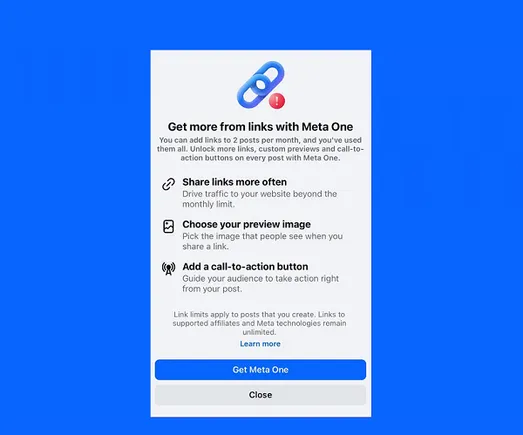
The landscape of organic social media marketing is undergoing a fundamental shift as major technology conglomerates re-evaluate the monetization of business utilities. Following the initial rollout of the Meta One for Business subscription packages, numerous professional account managers across Facebook have reported a significant restriction on their publishing capabilities. Specifically, non-paying business accounts are increasingly encountering platform limitations that cap external link posts at a meager two per month. This development signals a broader integration of Meta’s paid subscription model into its core social networking architecture, moving features that were once universally free behind a paywall designed to extract revenue from commercial enterprises.
The transition underscores a calculated evolution in how Meta handles professional content distribution. While early iterations of the restriction were isolated to limited testing phases, the concurrent deployment of Meta One for Business suggests that link-capping is shifting from an experimental feature to a permanent fixture of the platform’s commercial strategy. For digital marketers, brand managers, and small business owners who rely heavily on social traffic to drive external conversions, this policy shift requires a rigorous re-examination of organic distribution strategies.
Chronology of the Link Restriction Strategy
The origins of Meta’s push to monetize outbound links trace back to late 2025. In December of that year, the social media giant initiated a limited, localized test that restricted select business pages to just two link-containing posts per month. At the time, the company framed the test as an exploratory mechanism to evaluate how businesses utilized link volume and whether unrestricted access genuinely correlated with heightened commercial value. Platform representatives noted that the trial was intended to measure user behavior under constrained conditions, though industry analysts immediately recognized the trial as a precursor to a wider monetization push.
Throughout 2026, speculation mounted regarding how Meta would package these emerging restrictions. The ambiguity ended with the official introduction of Meta One for Business subscription packages. This tiered membership framework initially promised features such as enhanced support, diagnostic tools, and—crucially—the ability to add a variable number of outbound links to Instagram posts and Reels each month, depending on the subscriber’s chosen tier.
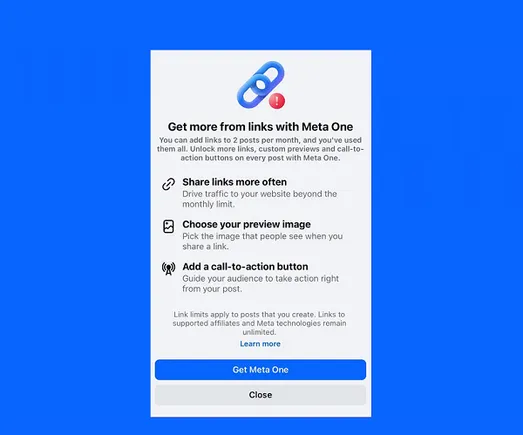
Although initial promotional materials for Meta One for Business did not explicitly list Facebook link limits as a core component of the subscription tiers, subsequent pop-up alerts shared by page managers this week confirm that the restriction has formally expanded to Facebook. Accounts operating without an active subscription are now receiving automated warnings that their outbound sharing capacity is strictly capped. Interestingly, publisher pages have thus far been granted exemptions from these specific caps, a tactical decision by Meta designed to ensure a continuous influx of news and journalistic content remains freely accessible to users scrolling through their feeds.
Data and Metrics Governing Meta’s Content Ecosystem
To fully comprehend the operational impact of Meta’s new link-posting limits, industry analysts point to the platform’s internal data regarding how users consume content. For years, Meta has published its Widely Viewed Content Report, a transparency initiative designed to shed light on the types of media that actually capture user attention across the platform. The metrics revealed in these reports paint a stark picture for marketers dependent on outbound link traffic.
According to data from the Q1 2026 Widely Viewed Content Report, an overwhelming 98.7% of all post views in the United States did not include a link to an external source outside of the Facebook ecosystem. This means that fewer than 1.4% of viewed impressions involved directing a user away from Facebook to a third-party website, blog, or e-commerce store.
This figure represents a dramatic, long-term decline in the visibility of external links. Historical comparisons highlight the steepness of this drop. When Meta first began publishing transparency insights in 2022, approximately 9.8% of viewed content included an external link. Over the subsequent four years, algorithmic shifts deliberately deprioritized outbound links in favor of native content—such as Reels, native video, images, and text-only posts—that keeps users inside the Facebook application for longer periods. By Q1 2026, that percentage had plummeted to a historic low of 1.3%.
Given these algorithmic realities, digital marketing experts suggest that the practical impact of a two-post link limit may be less catastrophic than business owners initially fear. Because organic reach for outbound links has been systematically throttled by the platform’s ranking algorithms for years, many standard business pages already experience negligible traffic from unpaid link posts. Consequently, the restriction largely formalizes a reality that has existed for some time: organic feed distribution on Facebook is overwhelmingly reserved for native, non-commercial content formats.

Corporate Strategy and the Three-Stage Monetization Playbook
The decision to charge for basic business utilities aligns seamlessly with Meta’s long-standing corporate playbook. The philosophy governing the monetization of the company’s family of apps was famously articulated by CEO Mark Zuckerberg during an annual stockholder meeting in 2016. At that time, Zuckerberg outlined a deliberate three-stage strategy for the lifecycle of any major social platform or feature:
- Build utility and attract a massive user base by offering core services entirely free of charge.
- Foster deep engagement and weave the product into the daily habits of both consumers and commercial entities, making the platform indispensable for business operations.
- Introduce monetization channels, shifting valuable features, expanded reach, or operational tools behind paid subscription models and advertising frameworks.
This phased approach has guided Meta’s evolution from a simple campus directory into a global advertising behemoth. Over the past decade, businesses were actively encouraged to build robust Facebook Pages, accumulate followers, and utilize organic posts to drive web traffic. As commercial dependence on the platform solidified, organic reach was steadily restricted, compelling businesses to rely on paid advertising tools like Meta Ads Manager to secure visibility. The introduction of Meta One for Business represents the next logical extension of this philosophy, moving beyond traditional ad spend into recurring subscription revenue for baseline functional capabilities.
Industry Reactions and Strategic Implications for Marketers
The expansion of the link-posting restriction has elicited a mixed response from the digital marketing community. While large enterprises with dedicated advertising budgets view the subscription fees as a standard cost of doing business in a monopolistic digital marketplace, small and medium-sized enterprises (SMEs) have expressed frustration. Critics argue that Meta’s approach amounts to a classic bait-and-switch tactic: inviting brands to cultivate communities on the platform for free, subsequently crippling organic reach, and finally demanding financial tribute to regain functionality that was once standard.
From a strategic perspective, marketing agencies are advising clients to adapt their digital distribution models to mitigate the impact of the new caps. Key recommendations include:
- Prioritizing Native Content: Shifting content creation away from outbound link sharing toward native formats—such as high-engagement Reels, interactive stories, and direct text or image updates—that foster community interaction without requiring users to leave the app.
- Utilizing Alternative Conversion Funnels: Leveraging the primary profile bio, direct messaging automation (such as Messenger bots), and native commerce tools to capture leads and drive sales without relying on traditional feed-based link posts.
- Evaluating Subscription ROI: Conducting a cost-benefit analysis of the Meta One for Business subscription tiers to determine whether the paid link allowances and administrative add-ons justify the recurring monthly expense based on historical conversion data.
- Diversifying Traffic Sources: Reducing reliance on social media algorithms by investing more heavily in owned media channels, including search engine optimization (SEO), email marketing newsletters, and SMS marketing campaigns.
Outlook for Platform Economics
As Meta continues to roll out its Meta One subscription framework globally, the digital ecosystem watches closely to see how user adoption unfolds. If a critical mass of businesses willingly adopts the paid tiers to secure their desired link volume, it will validate Meta’s strategy of monetizing utility beyond traditional advertising. Conversely, if resistance from smaller brands proves significant, the company may face regulatory scrutiny or user pushback regarding anti-competitive behaviors and the systematic degradation of free platform utility.
Regardless of short-term friction, the overarching trajectory is clear. The era of free, organic, high-reach link distribution across major social media platforms has effectively drawn to a close. Brands operating in the modern digital economy must increasingly budget for platform access, treating social networks less as free public town squares and more as proprietary infrastructure where visibility and functionality must be continually financed.