Decoding Netflix’s Collision Course: Plot Summary, Timeline Breakdown, and Ending Explained

Netflix has solidified its position as a global hub for high-concept international thrillers, and its latest Spanish-language export, Collision Course (originally titled Colisión), is a prime example. Directed by Daniel Sánchez Arévalo, who co-wrote the screenplay alongside Ramón Campos, the film debuted on the streaming platform on October 30. It rapidly ascended the charts to become the number-one non-English film globally, charting in the top ten across 25 countries and securing the number-three spot in the United States. Featuring an ensemble cast that includes Laia Costa, Karra Elejalde, Luis Zahera, Tamar Novas, Álvaro Cervantes, and Lluís Homar, the film blends the high-stakes tension of a traditional bank heist with a nonlinear, multi-timeline narrative structure reminiscent of Tom Tykwer’s 1998 German classic Run Lola Run.
Because of its complex, fragmented chronology, the film requires careful attention to detail. Below is a comprehensive breakdown of the historical context, the intricate plot mechanics, the four distinct timelines, and the ultimate implications of the narrative’s ambiguous conclusion.
Historical Background and Socioeconomic Context
To fully understand the motivations behind the characters in Collision Course, viewers must examine the socio-economic backdrop established at the outset of the film. Set in 2013, the narrative references the devastating aftermath of the Spanish financial crisis. During the preceding years, commercial Spanish financial institutions aggressively marketed complex, high-risk financial products—such as preferential shares and subordinate debt—to ordinary retail customers, including retirees, families, and everyday savers.
These products were frequently marketed as safe, high-yield alternatives to traditional savings accounts, masking the immense underlying risks. When the property bubble burst and the broader financial system collapsed in 2012, countless citizens lost their entire life savings and, in many cases, their residential properties. Compounding public outrage, the Spanish government subsequently executed a massive bailout of the failing banking sector, injecting more than 60 billion Euros of public funds into the institutions responsible for the crisis. This systemic betrayal forms the ideological core of Collision Course, transforming a standard criminal enterprise into a narrative about retribution, desperation, and structural injustice.
Chronology and Initial Heist Mechanics
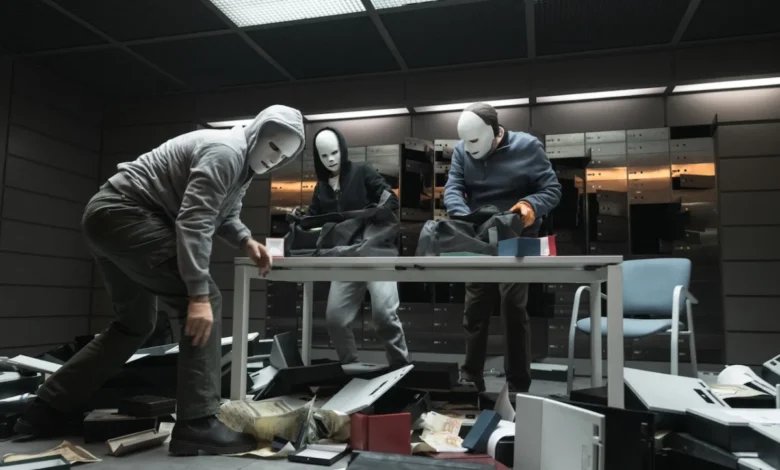
The narrative centers on Ernesto (Luis Zahera), a deeply unpopular bank employee who is visibly ostracized by his community. On the morning of the heist, an elderly man named Pedro (Karra Elejalde) approaches the bank before official opening hours, pleading for admission to deposit a winning lottery ticket valued at five million Euros. Ernesto relents, unknowingly admitting a Trojan horse. Pedro is actually part of a four-person crew, joined by Tomás (Tamar Novas), Carla (Laia Costa), and Raúl (Álvaro Cervantes), all of whom quickly breach the institution wearing masks.
The primary objective of the raid is a specific safety deposit box purportedly containing high-value diamonds. However, upon breaching the box, Pedro claims the diamonds are missing. The crew is forced to settle for secondary currency and valuables before making their escape. During the subsequent getaway, Tomás accuses Pedro of double-crossing the team and stealing the diamonds for himself. A physical altercation ensues inside the moving vehicle, resulting in a severe collision with a passing car on the passenger side. Pedro is killed instantly, establishing the narrative’s first branching timeline.
Subsequent police investigations reveal a stunning institutional twist: all four members of the supposed heist crew are actually law enforcement or civil servants. Pedro is a retired police sergeant; his son, Raúl, followed him into the force; Carla serves as a police lieutenant; and Tomás is a forensic evidence examiner. Furthermore, complicated personal dynamics complicate the conspiracy. Carla and Tomás are married, yet Carla is simultaneously engaged in a clandestine affair with Raúl, with whom she plans to flee once the operation concludes.
The Four Alternate Timelines
The core structural device of Collision Course relies on exploring four alternate trajectories, determined by who survives the initial vehicular accident. This branching narrative allows the filmmakers to dissect character motivations and institutional corruption from multiple vantage points.
-
The Death of Pedro
Following the initial crash that claims Pedro’s life, the remaining crew reluctantly burns the vehicle and the body to protect Raúl’s mother and evade detection. It is later revealed that Pedro did indeed steal the diamonds, hiding them on his person before his death. Authorities recover the gems from the burned wreckage and begin closing in on Raúl, who subsequently flees. In this timeline, Pedro’s backstory is fully contextualized: he lost his entire life savings due to predatory bank loans, forcing him and his wife to move in with their son. Pedro hides the stolen diamonds inside his son’s casket before being arrested due to forensic evidence—specifically, a boot print left in dog excrement outside the bank. Carla’s supervisor, Luis (Lluís Homar), discovers her affair with Raúl and her attempts to obstruct justice, leading to her arrest as well. -
The Death of Raúl
When the narrative resets to feature Raúl as the fatality in the car crash, the perspective shifts to examine the fallout from his loss. Pedro explains to investigators that his son attempted the robbery solely to alleviate the family’s crushing debt. Following Raúl’s death, investigators uncover deeper institutional connections. Carla’s superior, Luis, discovers that the targeted bank was the exact institution that financially ruined Tomás and Carla through predatory microloans. Grief-stricken, Tomás learns posthumously that Carla was pregnant. When Tomás confronts Raúl regarding the affair, Raúl insists he is sterile, casting doubt on the paternity of the unborn child and introducing a new layer of psychological tension among the surviving conspirators. -
The Death of Carla
In the timeline where Carla dies in the collision, Tomás emerges as the prime suspect in the investigation. Luis uncovers the shared financial grievances linking Tomás, Carla, Pedro, and Raúl to the targeted bank. Tomás discovers his late wife’s pregnancy and confronts Raúl. While Raúl admits to the affair, he maintains his inability to father children, leaving the true paternity of Carla’s child unresolved. The investigation intensifies around Tomás, exposing the systemic vulnerabilities of the bank employees and law enforcement officers who weaponized their badges against the very financial institution that victimized them. -
The Death of Tomás
The final primary timeline focuses on the aftermath of Tomás dying in the crash. Pedro once again steals the diamonds, while Carla distributes Tomás’s financial share of the heist. Carla confesses her pregnancy to Raúl, admitting uncertainty regarding the father, though Raúl expresses a willingness to raise the child regardless. Meanwhile, Ernesto acts as an intermediary for a mysterious sixth accomplice.
Upon attempting to liquidate his share, Pedro discovers that the diamonds are entirely counterfeit. Investigation reveals that the original owner of the safety deposit box anticipated the heist, swapped the genuine stones for fakes, and subsequently collected a fraudulent insurance payout while retaining the real diamonds.
The Grand Deception and Institutional Implications
As the investigation and private pursuits converge at the airport, the layers of deception unravel completely. Pedro tracks the original diamond owner to a meeting with Lola, a local barista who previously assisted police by identifying the suspects. Lola is revealed to be the mastermind’s sixth accomplice, seeking personal revenge against the bank because her brother was also financially ruined by predatory lending practices. Lola swallows the diamonds to smuggle them out of the country.
Simultaneously, Carla and Raúl track Ernesto to the airport, suspecting a betrayal. Ernesto intends to abscond with Lola, unaware that she has ingested the gems. However, the final twist exposes Ernesto’s overarching manipulation: the diamonds Lola swallowed are also clever fakes. Ernesto retains the genuine diamonds on his person, having successfully double-crossed both the heist crew and his own romantic partner. Lola discovers this betrayal mid-flight and severs ties with him, while Carla and Raúl are apprehended by law enforcement.
The Final Resolution and Alternate Reality
The film concludes by presenting a fifth, idealized scenario: a timeline where no collision occurs at all. In this uncompromised reality, the four conspirators successfully destroy all physical evidence of the crime and flee the scene in a stolen vehicle. As they drive down the highway, they pass a billboard bearing the slogan of the victimized institution: "Condal Bank: Your Money In Good Hands." Tomás remarks on an unpleasant odor, prompting Pedro to remind him of the dog excrement still lingering on his shoe from the bank floor.
The narrative cuts to black on this ambiguous note, leaving viewers to ponder the ultimate fate of the characters. By presenting these parallel outcomes, Collision Course functions less as a traditional linear thriller and more as an analytical study of desperation, moral compromise, and systemic exploitation. Rather than providing a single definitive resolution, the film invites audiences to weigh the consequences of institutional failure against individual human agency, offering a multifaceted critique of a financial system that routinely leaves ordinary citizens with little recourse beyond the extraordinary.
Related posts: