Yope Secures $12.3 Million Investment to Champion Algorithm-Free, Private Social Networking for the Next Generation

In a significant move challenging the prevailing paradigms of social media, Yope, a London-based startup, has successfully closed a $12.3 million funding round led by Northzone, bringing its total funding to $20 million. This substantial investment underscores growing investor confidence in Yope’s vision: a social networking platform entirely devoid of algorithms, advertisements, and public content, focused instead on fostering genuine connections within private "micro communities." The funding signals a potential shift in the social media landscape, as users increasingly express fatigue with the ad-driven, algorithmically manipulated environments of dominant platforms like Facebook, TikTok, Snapchat, and Instagram.
The Evolving Landscape of Social Media and User Discontent
The journey of social media has seen a dramatic transformation from its early days as a tool for connecting friends and family into colossal entertainment hubs. Platforms like Facebook and Instagram, once celebrated for bringing people together, have evolved into sophisticated advertising machines, optimizing for engagement through complex algorithms that often prioritize viral content and influencer culture over authentic interaction. TikTok’s meteoric rise further cemented this shift, emphasizing short-form video content and an endless, algorithmically curated feed designed to maximize screen time.
This evolution, however, has not been without its critics. Concerns over data privacy, the mental health impacts of constant comparison, the spread of misinformation, and the intrusive nature of targeted advertising have led to widespread user dissatisfaction. A growing segment of the online population, particularly younger demographics, has begun seeking alternatives that offer a more intimate, controlled, and authentic online experience. This sentiment is palpable in trends like the rise of "finsta" (fake Instagram) accounts, where users share more candid, unfiltered content with a select group of close friends, or the increasing reliance on private messaging apps for genuine communication rather than public feeds.
Yope’s co-founder and CEO, Bahram Ismailau, highlighted this critical gap in the market. Through extensive research involving over 100,000 interviews, aided by AI tools, Yope discovered that approximately 30% of young people were already utilizing "photo dump" or "spam" accounts for more private sharing. Furthermore, many individuals abstained from public sharing altogether, preferring messaging apps for maintaining connections. Ismailau noted, "Young people don’t have any place to self-express if they are not ready to be an influencer. Yet teens still want to do so; they just want more privacy." This insight forms the bedrock of Yope’s mission: to create a dedicated space for self-expression and connection without the pressures of public performance or algorithmic curation.

Yope’s Core Proposition: Privacy and Authenticity
At its heart, Yope is designed as a direct counter-narrative to the prevailing social media model. Its foundational principles are rooted in user control and intimacy. Accounts are private by default, ensuring that content shared remains within a trusted circle. Crucially, the absence of an algorithmic feed means users see content from their chosen connections in a chronological, unadulterated manner, rather than a system dictating what they "should" see based on engagement metrics.
The platform’s business model further differentiates it. Eschewing the ad-supported revenue streams that dominate the industry, Yope is developing a premium, subscription-based experience for power users. This approach, while challenging in a market accustomed to "free" services, aligns with a growing consumer willingness to pay for privacy, ad-free experiences, and enhanced features, as evidenced by the success of services like Spotify Premium, Netflix, and various productivity apps. This strategy allows Yope to prioritize user experience and data privacy without the inherent conflicts of interest that arise from an ad-driven model.
Unpacking the User Experience: Customization and Connection
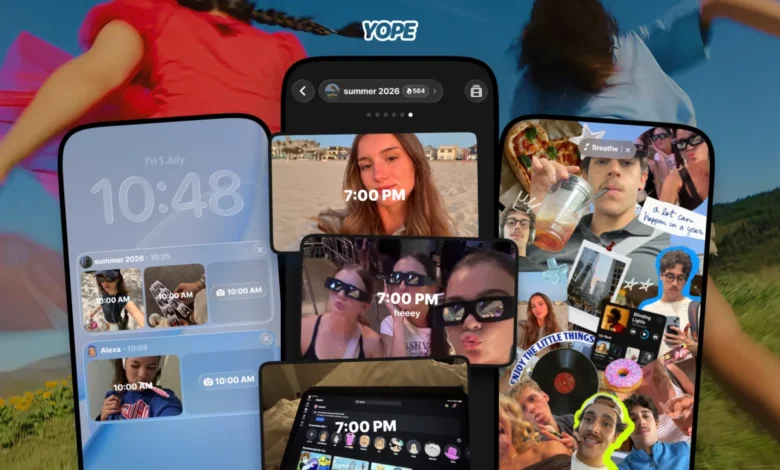
Yope’s user interface and feature set are crafted to reinforce its commitment to personalization and genuine interaction. Users create their profiles by sharing photos, which can be transformed into cut-out stickers. Instead of traditional photo albums, these images are displayed in a collage-like, almost chaotic arrangement across each user’s "wall," evoking a sense of creative freedom and individuality. This design choice resonates with the early days of MySpace, where users had unprecedented control over customizing their profiles with backgrounds, music, and layout, fostering a strong sense of personal ownership over their digital space. Soon, Yope users will be able to further personalize their walls with interests, favorite music, mini-games, and custom colors and wallpapers, deepening this sense of individual expression.
Beyond aesthetics, Yope integrates features designed to facilitate dynamic interactions within private groups. The app offers standard in-app messaging, allowing for seamless communication. Leveraging AI, Yope creates "recaps of top moments," providing a personalized summary of interactions. It also offers lock screen widgets that display friends’ photos, maintaining a constant, subtle connection. The onboarding process is designed to guide users through setting up these features, granting necessary permissions, and encouraging them to add real-life connections to initiate private chats.

A particularly innovative aspect of Yope’s offering is its integration of AI not for content generation, but for enhancing connections. Ismailau clarified this distinction, stating, "We don’t believe in using AI to create content; rather, it sees AI as a tool that can help create better connections." This includes AI-powered mini-games that friends can play together, a feature slated for release within the next month. Even more ambitiously, Yope aims to leverage AI to help users translate their online connections into real-life meetups, suggesting activities like buying tickets to events or finding suitable venues for shared experiences, such as watching a football game. This ambition to bridge the digital and physical worlds positions Yope uniquely against platforms that primarily focus on digital consumption.
Strategic Insights from User Research
Yope’s development trajectory is a testament to rigorous user research. The company’s decision to conduct over 100,000 interviews globally, utilizing AI to analyze these vast qualitative datasets, provided a granular understanding of how younger generations interact with and perceive social media. This deep dive revealed a fundamental disconnect: while existing platforms offer unparalleled reach and content variety, they often fail to cater to the innate human desire for intimate, private, and authentic social interaction among close friends and family.
The observation of "photo dump" or "spam" accounts was a critical insight. These unofficial, secondary accounts on platforms like Instagram served as an organic workaround for users seeking privacy and authenticity, separate from their curated public personas. Yope recognized this behavior not as a niche preference, but as a widespread demand for a dedicated platform that inherently supported such interactions. By building a platform where privacy is the default and micro-communities are the central organizing principle, Yope aims to formalize and optimize this user behavior, providing a purpose-built environment for what users were already attempting to create on less suitable platforms.
The Funding Catalyst: Northzone’s Vision
The $12.3 million funding round, led by Northzone with participation from Inovo, Redseed, and Geek Ventures, underscores the investment community’s belief in Yope’s disruptive potential. Northzone, a venture capital firm with a notable track record of backing successful consumer applications like Spotify and Klarna, actively sought out Yope, rather than the other way around. This proactive investment highlights the strategic importance Northzone places on the burgeoning demand for alternative social media models.

Pär-Jörgen Pärson, a partner at Northzone, articulated the firm’s rationale in a statement: "Yope is a fresh, empowering and safe take on social media where the users are in full control of their experience in contrast to the predatory practices of Meta, TikTok or X." This strong endorsement frames Yope as not just another social app, but as a necessary evolution, offering a sanctuary from the often-criticized tactics of industry giants. The investment brings Yope’s total funding to $20 million, providing significant capital to further develop its product, expand its team (currently around 35 people), and establish a crucial presence with an office in the United States, a key market for scaling consumer applications.
It’s also worth noting that Yope’s current iteration is the result of two prior pivots, demonstrating the team’s agility and commitment to finding a compelling product-market fit. An earlier version of the company had been covered by TechCrunch, highlighting a continuous journey of refinement and adaptation over roughly two years to arrive at its current, focused model.
Scaling Without Virality: A Unique Challenge and Promising Metrics
One of the most significant challenges for any new social media platform is achieving scale, particularly when deliberately eschewing the viral mechanisms of algorithms and public content. However, Yope’s early metrics suggest it is navigating this challenge effectively. The platform boasts nearly 15 million registered users, who collectively share between 10 million and 20 million pieces of content weekly, encompassing individual photos, videos, and stickers. These figures indicate robust and consistent user engagement.
Ismailau further claims that more than 50% of Yope’s users open the app at least five days per week, classifying them as power users. This level of regular engagement is a critical indicator of retention and stickiness, vital for a subscription-based model. Intriguingly, the platform isn’t just attracting young users; approximately 20% of active users have invited an older family member to join them, suggesting a broader appeal for private, intimate sharing that transcends typical demographic boundaries for new social apps. This organic expansion into multi-generational use cases further validates Yope’s core premise of fostering genuine connections.
Echoes of the Past, Glimpse of the Future

The design philosophy of Yope, particularly its emphasis on customizable profiles and user control, intentionally recalls the early days of platforms like MySpace. Before the homogenization of social media feeds and the dominance of algorithmic curation, MySpace users could intricately personalize their profiles, choosing layouts, colors, and even embedding music, creating a unique digital reflection of their personality. This era fostered a sense of creative freedom and individual expression that has largely been lost in the standardized templates of modern social networks. Yope’s reintroduction of these elements taps into a nostalgic desire for a more personalized and user-driven online identity, offering a refreshing contrast to the often-generic profiles on mainstream platforms.
AI as an Enabler, Not a Creator
Yope’s judicious application of Artificial Intelligence is another distinguishing factor. While many emerging platforms are exploring AI for content generation—creating images, videos, or text—Yope firmly positions AI as an enabler of connection, not a substitute for human creativity. The planned AI-powered mini-games aim to provide new, engaging ways for friends to interact. More profoundly, the ambition to use AI to facilitate real-world meetups – helping users find events, book tickets, or locate suitable gathering spots – represents a forward-thinking approach to social technology. Instead of merely keeping users glued to their screens, Yope seeks to leverage AI to enhance and deepen offline relationships, addressing a common criticism that social media often isolates rather than connects. This philosophy positions Yope as a tool for enriching lives beyond the digital realm.
Market Implications and Future Outlook
Yope’s emergence and significant funding round carry several implications for the broader social media market. Firstly, it validates the growing demand for alternatives to the established giants. As user fatigue with advertising, algorithmic control, and privacy concerns intensifies, platforms offering a clear, value-driven differentiation are likely to attract a dedicated user base.
Secondly, Yope’s subscription-based model will be a crucial test case. While scaling without ad revenue is challenging, a loyal user base willing to pay for privacy and quality could prove a sustainable path. The success of other premium digital services suggests that users are increasingly willing to pay for experiences that align with their values.

Thirdly, the focus on "micro communities" and real-world connections could redefine what "social" means online. In an era where online interactions often feel superficial or performative, Yope champions intimacy and authenticity. If successful, this could inspire other platforms to reconsider their design principles, potentially shifting the industry away from pure engagement metrics towards more meaningful interaction.
However, Yope faces formidable challenges. The network effect is powerful, and breaking the entrenched habits of billions of users on established platforms requires sustained innovation and significant marketing. Competing with the vast resources and technical capabilities of Meta or ByteDance will be an uphill battle, even with a clear value proposition. Yope must continually demonstrate the tangible benefits of its ad-free, algorithm-free, and private model to justify its subscription offering and maintain its growth trajectory.
Company Growth and Expansion
With the new capital, Yope is poised for significant expansion. The primary focus areas for the funding include further product development, refining existing features, and introducing new ones like the AI-powered games and real-life meetup facilitators. The company also plans to expand its team, which currently stands at around 35 individuals, by hiring top talent to accelerate its development roadmap. Crucially, the establishment of a United States office signifies Yope’s ambition to penetrate one of the world’s most competitive and influential technology markets, aiming to replicate its initial success on a global scale.
Yope is currently available for free download on both iOS and Android platforms, inviting users to experience a reimagined approach to online connection. As the digital landscape continues to evolve, Yope’s bold bet on privacy, authenticity, and user control presents a compelling vision for the future of social networking.