Erica Synths Bullfrog Drums Review: Richie Hawtin Collaboration Delivers Serious Performance Power

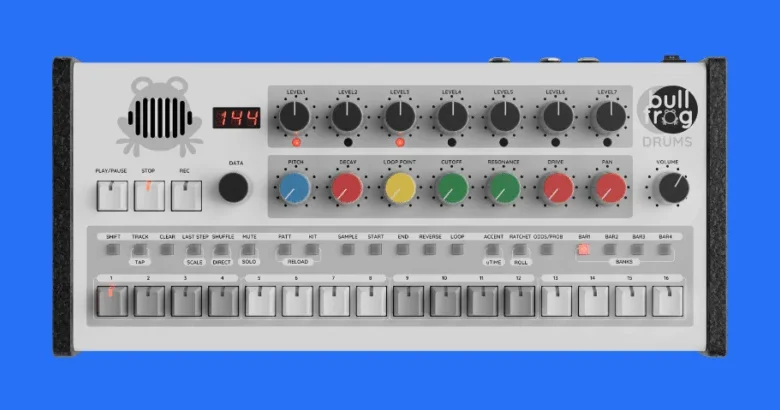
The intersection of electronic music education and professional performance hardware has historically been a tenuous bridge, often resulting in compromises that satisfy neither classrooms nor festival stages. However, the release of the Bullfrog Drums—developed in collaboration with electronic music pioneer Richie Hawtin and manufactured by Erica Synths—challenges this paradigm. Priced at approximately €600, the sample-based groovebox expands upon the legacy of the Bullfrog synthesizer line, packaging a robust set of sound design tools and a hands-on sequencing workflow into a rugged aluminum chassis. Designed to strip away menu-diving in favor of immediate tactile control, the instrument has quickly drawn attention from producers and performers navigating the crowded modern market of hardware samplers.

Background and Context of the Bullfrog Ecosystem
The development of the Bullfrog series stems from a shared vision between Erica Synths founder Girts Ozolins and veteran techno artist Richie Hawtin. The initiative initially launched with an educational synthesizer aimed at demystifying subtractive synthesis for students and novices without sacrificing the raw, unfiltered audio character associated with Erica Synths’ Nordic engineering philosophy.

While marketed under the umbrella of educational tools—a designation intended to reassure buyers and lower the barrier to entry—the hardware was engineered from the ground up to withstand professional studio environments and live tour itineraries. The introduction of the Bullfrog Drums extends this educational-yet-professional ethos into the realm of rhythm production. By focusing on fundamental sound-shaping capabilities rather than infinite digital menus, the collaboration aims to counteract modern fatigue associated with software-heavy workflows and over-complicated hardware interfaces.
Anatomy and Technical Specifications of the Bullfrog Drums

Stripped of its pedagogical marketing, the Bullfrog Drums functions as a dedicated, sample-based drum machine and performance instrument optimized for rapid ideation. The hardware architecture revolves around seven dedicated mono audio voices distributed across seven distinct tracks. An eighth track is dedicated entirely to CV (Control Voltage) and gate outputs, establishing a direct bridge to modular synthesizers and external analog gear.
Each of the seven sound-generating voices is equipped with a comprehensive suite of hands-on controls. Users have direct physical access to level adjustments, a versatile two-way filter featuring selectable high-pass and low-pass modes, resonance, pitch shifting, drive, decay time, loop length, and panning. Factory samples provide an immediate out-of-the-box groove foundation, though the open architecture invites users to load custom audio via USB, ranging from single-cycle synth waveforms to field recordings and vocal snippets.

Audio capture is facilitated via a built-in microphone for lo-fi sampling or a standard line input. To maximize the utility of the five-second per-voice sample limit, producers can halve the sample rate when longer audio captures are required. Furthermore, recent firmware updates introduced a pseudo time-stretch function, slicing audio across the sixteen pad triggers to yield complex, fractured textures reminiscent of granular synthesis or avant-garde electroacoustic compositions.
Workflow and Sequencing Capabilities

The operational core of the Bullfrog Drums relies on a tactile step sequencer designed to eliminate the friction typically introduced by deep menu structures. Every voice features dedicated parameter knobs, allowing producers to reshape filtering, drive, and envelope characteristics in real time while a rhythm pattern loops continuously.
The sequencing engine incorporates advanced performance features including accents, ratchets, rolls, probability triggers, microtiming adjustments, and comprehensive parameter locking. Trig conditions allow individual steps to execute selectively on specific pattern iterations, enabling static one-bar loops to evolve organically over extended periods. Users can program these variations manually or record parameter automation in real time during live playback.

By integrating the eighth track’s CV and gate connectivity, the device transcends its identity as a standalone drum machine, functioning instead as the master clock and control center for a broader hardware ecosystem. This capability positions the instrument favorably alongside competitors like the Elektron Digitakt II and the Polyend Tracker+, despite offering a more focused and streamlined track count.
Market Implications and Competitive Landscape

The launch of the Bullfrog Drums arrives at a time when the hardware groovebox market is densely populated with feature-heavy samplers. Retailing at approximately €600, the instrument occupies a fiercely contested price bracket. While competitors often boast sixteen or more tracks and extensive digital feature lists, the Bullfrog Drums differentiates itself through ergonomic efficiency and immediate workflow velocity.
Industry analysts and early adopters note that the device’s primary competitive advantage lies in psychological ergonomics—minimizing the distance between a musical concept and its physical execution. By deliberately restricting certain digital luxuries, such as unlimited sample storage or endless sub-menus, Erica Synths and Richie Hawtin have championed a design philosophy centered on constraint-driven creativity.

Furthermore, the hardware’s physical build quality ensures longevity on the road. Encased in the same sturdy aluminum chassis as its predecessor synth, the drum machine is engineered to endure the physical demands of live electronic music touring.
Future Outlook and Ecosystem Expansion

The release of the Bullfrog Drums aligns with Erica Synths’ broader strategy of expanding its hardware catalog into comprehensive live performance setups. Industry insiders anticipate the release of a companion performance mixer designed specifically to unify the Bullfrog synthesizer and drum machine into a cohesive, standalone live rig.
While users have noted minor feature requests for future firmware iterations—such as expanded trigger condition parameters and heavier saturation gain staging—the consensus within the professional audio community is largely positive. The instrument successfully bridges the gap between accessible educational tooling and uncompromising stage performance, proving that hardware design can prioritize creative immediacy without sacrificing sonic depth.
Related posts: